For centuries, the question of Shakespeare's authorship has puzzled readers, scholars, and researchers.
This blog presents a comprehensive solution:
The Multi-Pseudonymity Theory (MPT).
According to my research, Christopher Marlowe — officially declared dead in 1593 — survived and continued to write under multiple pseudonyms.
He certainly had an interests in the arts, also in writing in Shakespeare …..I should make a point here … he was a great believer that the person called Shakspere was not the author of the Plays and therewas a book he got his inspirations from which was by a man called Looney , a rather unfortunate name because it suggests the idea he was crazy, but he was very insistent that people did not call him loony or little like that.. -
but the book has made a very strong case, and I was quite persuaded and I think I am rather persuaded that the case that Shakespeare or the person William Shakspere who had no education and no books whatsoever which is a very striking fact and no indication that - apart from a few signatures – that he ever wrote anything
asked if he think it was Bacon Penrose replied:
No ! I think the view that my father followed .. I think is the most probable one…8:26 it was Edward de Vere, the Earl of Oxford.
But i mean that the case for a particular individual is much weaker than the case against Shakespeare
….the fact that the person who had no books and was probably illiterate could write those amazing plays seem to me quite a strong case…but the case for any particular individual was not so strong… but I thought that the case for Edward de Vere was not so bad .--- May be that was the right answer, but i wouldn’t…I have no real independent… – apart from forming views I went to see the Tempestwith my family not so long ago and that seemed to me very clearly a play where the author himself was revealing himself…and the person Prospero was clearly somebody who was in the aristocracy , he was not somebody who came up from nothing , so I do feel there was something in the case...
OPEN —> Heading--> Home -->Videos -- Shorts -- Posts
->Popular
In April 23 2016 the world celebrated the 400th anniversary of Shakespeare’s death .-
Shakespeare,"an almost unknown human beeing, a mythical figure much like Jesus (as William Leahy wrote). But like Jesus we do not celebrate the real man, as we know almost nothing about him, we celebrate the invisible, almost "fictitious" Poet Shakespearewho is associated with the plays in the same way that we celebrate Jesus as he appears in the Gospels."
According to William Leahy (Vice chancellor of the Brunel University, London),their function is to perpetuate the myth, build the brand, continue the fiction of this great man, this holy icon. That is their function – not to be real, but to be “there”.
If we really celebrate the invisible, almost "fictitious" Poet [named] Shake-speare who is associated with the plays (as Leahy put it) why Leahy never dared at least to discuss in more details a corresponding working hypothesis and theory of Marlowe, who in fact had to remain invisible and write under fictitious (or semi-fictious) pseudonyms?
Unfortunately an opaque "death certificate" [of Marlowe] is an unsurmount-able obstacle, also for Leahy, even though it was discovered late, in the 20th century (1925), when the Stratford myth had already been fully established for almost hundred years.-
William of Stratford cannot have been the author of the First Folio Plays attributed to him.
They take, however, the view of a "Multi-A u t h o r s h i p Theory" (including Fletcher, Peele, Marlowe, Kyd, Middleton, Daniel, Massinger, A-Bacon, Greville) compared to
an opposite "Multi-P s e u d o n y m i t y Theory" (including Fletcher, Peele, Marlowe, Kyd, Middleton, Daniel, Massinger, Breton Markham, Wither) of this Marlowe Blog who sees in Marlowe the single Genius, who has created a more extensive work than previously adopted under a variety of pennames/ aliases/ pseudonyms/ signatures etc.
The flyer of the new book "Shakespeare Unravelled Court plays: the 1623 deception" by Michael and Pauline Black tells us: it delves into the history and controversy surrounding William Shakespeare’s z3) and sheds light on doubts about Shakespeare’s authorship .
The book looks into the reasons which prompted the concealed authorship, principally the fear of Spanish domination at the time because of the impending royal marriage of Crown Prince Charles and a Spanish Princess.
According to the authors , Shakespeare's dramas were written by well-educated writers – certainly not by the attributed author, Shakespeare.”
The book makes the astonishing claim that the well known life and career of Shakespeare - poet, playwright and Swan of Avon - was largely invented after his death. The real authors of the 1623 First Folio used the dead Shakespeare’s name to shield themselves from the censorship of the time. Until then, even in his home town, Shakespeare had been honoured as a businessman who invested in the theatre and occasionally acted.
_________________________
A major objection to the m u l t i- a u t h o r theory(among others) is that it is not possible or extremely unlikely that within in a narrow time frame of a few decades [suddenly] simultaneously so many exceptional unrivaled poetic genius (a la Mozart) did exist and were able to compose such incomparable oustanding "literary" sonatas, symphonies etc. .
The "orthodox" Oxfordian Alexander Waugh, Honorary President of the Shakespeare Authorship Coalition, Co-editor of „Shakespeare Beyond Doubt? Exposing an Industry in Denial“ (2013) gave a talk [s. Video below] at the 2015 Shakespeare Oxford Fellowship Conference in Ashland, Oregon,
Alexander Waugh (1963 - 2024) Waugh dealt with the problem that in Shake-speare Sonnets the poet reveals that he is embroiled in a ‘vulgar scandal’ that has made him ‘a motley to the view’ and a ‘disgrace in men’s eyes. ’Even though at the beginning he warns the audience that there are high risks involved in interpreting the sonnets biographically: he does exactly that! ————
In looking for any literary evidence of such a vulgarscandal, he selected early literary references to Shakespeare such as :
How could it happen that Waugh completely ignored Marlowe who suffered the most dramatic
vulgar life scandal of all english poets?
Almost 100 years ago, in 1923, 2 years prior (!!) to Hotson's discovery of the "Latin" Coroner's Report , Archie Websterconcluded that not Shakespeare, but Marlowe must have been the author of the sonnets. He found the extraordinary life of Marlowe and...
... his [ Marlowes] tragic "vulgar scandal" fully reflected in the sonnets
Can anyone explain who biographically - if not Marlowe - could represent or mirror the subsequent contextual extracts of the sonnets of Shakespeare?
_________ Read extracts of Shakespeare‘s Sonnets _________________________________ Fear, Anxiety, Threat of life, Imprisonment, Faked death
Son.33: »Anon permit the basest cloudes to ride, With ougly rack on his celestiall face« Son.68: »To live a second live on second head« Son.73: »A few do hange upon those boughs [Gallow] which shake against the could« Son.74 »So then thou hast but lost the dregs of life, The prey of worms,my body being dead, The coward conquest of a wretch’s knife, Too base of thee to be remembered (…) But be contented when that fell arrest Without all bail shall carry me away« Son.86: »Aboue a mortall pitch, that struck me dead?« Son.107: »Not mine own fears nor the prophetic soul Of the wide world dreaming on things to come Can yet the lease of my true love control, Supposed as forfeit to a confined doom.« Son.112: »That all the world besides me thinkes y’are dead.«
Living in Exile, Banishment,, Flight, Concealment, Travels, Trennung, Separation
Son.26: »Til then, not show my head« Son.28: »The one by toil, the other to complain How far I toil, still farther off from thee« Son.29: »I all alone beweepe my out-cast state« Son.30: »For precious friends hid in deaths dateles night,« Son.33: »And from the forlorne world his visage hide« »Stealing vnseene to west with this disgrace:« Son.39: »Even for this let us divided live, And our dear love lose name of single one, That by this separation I may give That due to thee which thou deserv’st alone And that thou teachest how to make one twain, By praising him here who doth hence remain.« Son.44: »For then, despite of space, I would be brought, From limits far remote, where thou dost stay.« Son.61: »Is it thy spirit that thou send’st from thee So far from home into my deeds to pry« Son.71: »Give warning to the world that I am fled From this vile world with vildest wormes to dwell:« Son.97: »How like a winter hath my absence been From thee, the pleasure of the fleeting year!« Son.98: »From you have I been absent in the spring« Son.109: »Though absence seem’d my flame to quallifie, As easie might I from my selfe depart, (…) Like him that trauels I returne againe, Iust to the time, not with the time exchang’d,«
Son.25: »is from the booke of honour rased quite, And all the rest forgot for which he toild:« Son.26: »And in them-selues their pride lies buried, For at a frowne they in their glory die.« Son.29: »When in disgrace with Fortune and mens eyes, I all alone beweepe my out-cast state« Son.33: »Stealing vnseene to west with this disgrace:« Son.34: »That heales the wound, and cures not the disgrace Nor can thy shame give phisicke to my griefe Though thou repent, yet I have still the losse« Son.36: »So shall those blots that do with me remain, Without thy help, by me be borne alone. I may not evermore acknowledge thee, Lest my bewailed guilt should do thee shame Though in our liues a seperable spight« Son.37: »So I, made lame by Fortune’s dearest spite So then I am not lame, poor, nor despised« Son.66: »And right perfection wrongfully disgrac'd »and Art made tongue-tied by Authority Son.72: »My name be buried where my body is, And liue no more to shame nor me, nor you For I am shamd by that which I bring forth,« Son.90: »Now while the world is bent my deeds to cross O, for my sake do you with Fortune chide,« Son.109: »So that my selfe bring water for my staine, Neuer beleeue though in my nature raign’d, All frailties that besiege all kindes of blood, That it could so preposterouslie be stain’d, To leaue for nothing all thy summe of good:« Son.111: »The guilty goddess of my harmful deeds Thence comes it that my name receives a brand Your love and pity doth th’ impression fill« Son.112: »Which vulgar scandal stamped upon my brow« Son.121: »When not to be, receives reproach of being (…) Or on my frailties why are frailer spies (…) At my abuses, reckon vp their owne(…) My deedes must not be shown« Son.125: »Hence, thou suborned Informer, a true soul When most impeached, stands least in thy control.«
Anonymity and Namelessness
Son.25: »Let those who are in favour with their stars, Of public honour and proud titles boast, Whilst I whom fortune of such triumph bars Unlooked for joy in that I honour most« Son.71: »O if (I say) you looke vpon this verse, When I (perhaps) compounded am with clay, Do not so much as my poore name reherse;« Son.72: »My name be buried where my body is, And live no more to shame nor me nor you« Son.76: »Why write I still all one, ever the same, And keep invention in a noted weed,
That every word doth almost tell my name,
Showing their birth and where they did proceed?« Son.81 »Your name from hence immortal life shall have, Though I, once gone, to all the world must die« Son.111 »Thence comes it that my name receives a brand«
Son.28 »But day doth daily draw my sorrows longer, And night doth nightly make grief’s length seem stronger.« Son.30 »Then can I drown an eye, unused to flow, (…) Then can I grieve at grievances foregone, And heavily from woe to woe tell o’er The sad account of fore-bemoaned moan, Which I new pay as if not paid before.« Son.34: »Nor can thy shame give phisicke to my griefe« Son.50: »The beast that bears me, tired with my woe, Plods dully on, to bear that weight in me, (…) For that same groan doth put this in my mind: My grief lies onward, and my joy behind.« Son.64 »When I haue seene such interchange of state, Or state it selfe confounded, to decay, Ruine hath taught me thus to ruminate«
Marlowe's Life smotto
Son.73 »In me thou seest the glowing of such fire That on the ashes of his youth doth lie, As the death-bed whereon it must expire, Consumed with that which it was nourished by.«
Why there is not a single letter, note, manuscript,
correspondence, payment EVER discovered
from Shakspeare (Stratford). ?
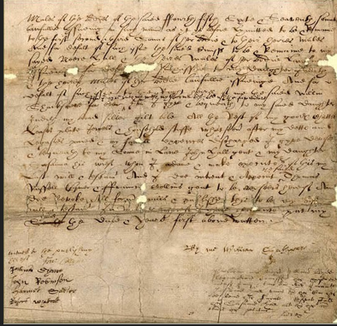
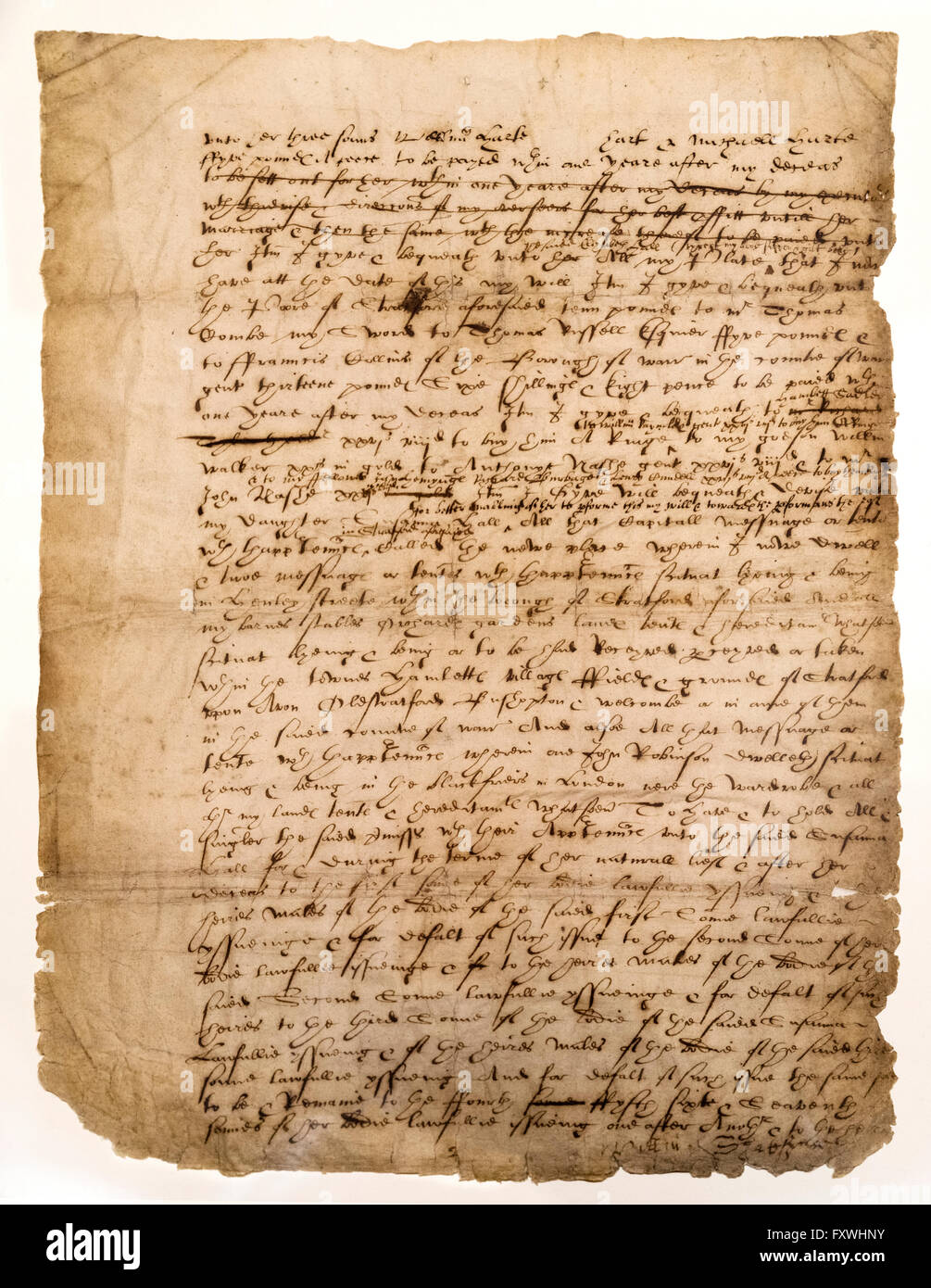
Shakspere's will page 3 1616
Signature Shakespeare legal document 1610
For some strange reasons not a single written letter, note, manuscript, correspondence does exist for William Shakespeare (Stratford). Judging his handwriting skill we are dependent on 6 existing signatures. Shouldn't these few examples of a lack of motor writing skill be sufficient to establish - at least - areasonable doubt that William of Stratford could have written all the immense works of the "Shakespeare Canon" ?.
Shakspere's Will, page 3: belated insertion to my wife " my second best bed
The fact that William Shakspere (Stratford) in his will left his wife nothing else than a bed seems to be a greater problem than the problem why only the "second best" bed.-
.....an even bigger problem is why "the second best bed" as well as the rings to "Heminges & Condell" (s.next blog) were insertedso belatedly in a finished text.
As long as a Shakspere authorship problem is generally denied, very likely a more profound background of the true scribe of Shakspere's will (s.Blog 426) as well as the (allegoric) meaning of the strange belated insertions will never be discussed, .
"...to my ffellowes John Hemynge Richard Burbage and Henry Cundell, 26 shillings 8 pence apiece to buy them rings
The head of legal records of The National Archives (TNA- the UK government's official archive, containing 1,000 years of history") has reinvestigated Shakespeare’s original will and came to the conclusion that parts of Shakespeare's will had to be redated .- Page two has been identified as a page reused from a previously unknown will, written earlier, the other two pages were rewritten in January 25, 1616, and that all three pages were slightly amended in darker ink in late March 1616.
The three-page will is dated 25 January1616, with January crossed out and replaced by March.
Due to new technical analysis of infrared rays and multispectral analysis, it has been concluded that the paper and ink of the three folios pages are not uniform, and page 2 (click details) were written with different paper and ink.-
In late March a small number of additions in a darker ink were squeezed (!) into the will at this point in time, including the change from January to March, including the bequests of mourning rings to his friends [Heminge, Burbage & Condell s.Faksimile], and the [second-best] bed to his wife.
Why did it never surprise Shakespeare experts that the "ingenious superbrain" Shakespere at first completely forgot in his will to leave even a single legacy for the theater and only belatedly squeezed between two lines an additional line bequeathing fellows (Heminge, Condell) with a ring, without considering more formative figures such as Ben Jonson or Henry Wriothesley?
VIDEO LAST WILL & Testament
VIDEOS – Complete Video Archive:VIDEOS – Complete Video Archive:
It's highly regrettable, that Oxfordians have comitted themselves so definetely and finally!
Oxfordian Tom Regnier 1950- 2020 († from Corona)
Tom Regnier, president at the Shakespeare Oxford Fellowship (SOF), an appellate lawyer in South Florida gave (besides earlier speeches) a fine presentation April 11 2016 at GableStage in Coral Gables Florida
Did Shakespeare really Write Shakespeare? –
Was William from Stratford able to write at all?
The basic knowledge and insights ( Regnier reports) has now circulated for almost 100 years . It has - remarkably - not led to a paradigm shift.
Whence he derives his expectations and hopes, that in another 100 years the Oxfordian case (Shakespeare was the penname of the Earl of Oxford) will be accepted general knowledge ?
Conclusion: Whereas Tom Regnier's question is fully justified (provided it is formulated more inocuous: Did Shakspere [of Stratford] really write Shakespeare [of the works] ?) his answer is not sufficiently justified.-
A paradigm shift is overdue and necessary !
It's highly regrettable, that Oxfordians have comitted themselves so definetely and finally!
Position and Influence from a Historical Perspective
Author: Thomas W70 (blog) Source:der Freitag 2014
Content: An essay written for the 450th anniversary of Christopher Marlowe, placing him in relation to Shakespeare. The text explores the aesthetic, historical, and stylistic connections between Marlowe and Shakespeare, thereby indirectly addressing questions of influence, and collaboration.
Christopher Marlowe is also celebrating his 450th birthday this year. The significance that Marlowe had for Shakespeare can hardly be overestimated and goes far beyond the obvious influences he exerted on Shakespeare’s early tragedies and histories. It was Marlowe’s personality, with its dangerous unpredictability, that had an inspiring effect on Shakespeare, giving his work decisive impulses and opening up new perspectives. Even though they were fundamentally different in temperament, they were brothers in spirit. When reflecting on Shakespeare, taking a look at Marlowe as well can be extremely helpful. Viewed from this three-dimensional perspective, Shakespeare emerges much more vividly within a historical and aesthetic context.
His [Marlowe's] enormous self-confidence was by no means without justification. He was endowed with genius: his first play,Dido, Queen of Carthage, which he probably wrote at not yet twenty for a company of boy actors, already displays an impressive assurance in conception and in verse. His first play written for the public stage, Tamburlaine the Great, was an immediate sensation, and from then on success was his constant companion.
------------------------
Personal C o m m e n t a r y:
It is difficult not to find it regrettable—and indeed astonishing—that the author, despite the situation outlined, appears never to have encountered the long-standing scholarly debate surrounding a Marlowe–Shakespeare authorship controversy.