September 19, 2016

(455) Josuah Sylvester and Marlowe's Massacre at Paris

JOSHUA   S Y L V E S T E R  (5)
 .... and Marlowe's Massacre at Paris 
------------------------------------------
Sylvester conflated metaphorically the rare flower Lotos 
(a divine immortalizing pen) with "The Massacre at Paris" ?

Christopher Marlowe: The Massacre at Paris (1594)

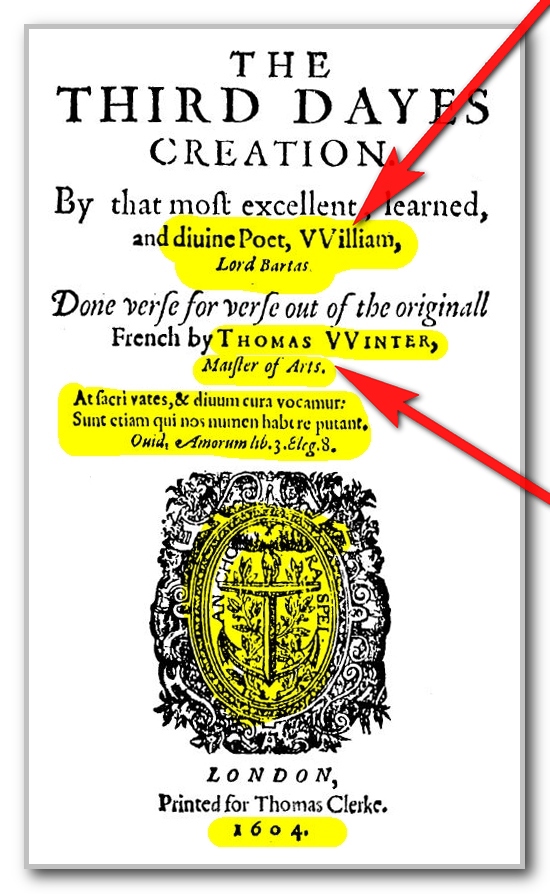
     Du Bartas "The third dayes creation" (1604)


Du Bartas: His Divine Weeks, translated
and written(!) by Josua Sylvester 1605
Excerpt of an interpolation of "The Masscre at Paris" of Sylvester into "The Third Days Creation"


Josuah Silvester's translations of the  French Poets  Du Bartas  works "La Sepmaine; ou, Creation du monde "(1578), and "La Seconde Semaine" (1584-1603) were  extremely popular in early modern England. 

__________________________________
Sylvester's most significant translation  “Bartas his devine Weekes and Workes (1605) was reprinted six times by 1641 (s.Faksimile 1605)


It is noteworthy that the translation  "The Third Daye's Creation" 1604  (by Thomas Winter s. Faksimile)  was not only significantly altered in the final version  “Bartas Devine Weekes and Workes" 1605) but Sylvester also  interpolated several substantial own  contributions.

For instance Josuah Sylvester as "Thy Servant of deer S.BARTAS"  in "THE THIRD DAYES CREATION (1604)" within the section of the Beginnings of Vegetations interpolates a remarkable personal information by weaving one rare flower, The LOTOS whose wondrous nature had more worthy been of Sylvester's "divine, immortalizing Pen": from his sight, when the river SEIN(E) did swell with Bloud, the Flower [Lotos] sunk under the crimson flood, when Medices, Valois, Guise stained Hymens [Godess of Marriage] Roabe  with Heathen cruelties.

He had to keep his chamber at Paris because of the Massacre during the Night of Bartholomew /Because the sun, to shun so vile a view, his chamber kept;and wept with Bartholmew". 
As a metaphor the Lotos dived deeper and deeper til midnight: then remounthet toward Day:....

There are plausible speculations (***)  and indications (*** )... 

... that Marlowe as an 8 year old page belonged to the entourage of  Philip Sidney  and his  servants on his 3 year European tour  .-  The Sidney party arrived in Paris just a few days before the St. Bartholomew’s Day Massacre of the Huguenots on August 24, 1572.

Sir Francis Walsingham was Elizabeth’s ambassador in Paris, and Sidney and his entourage took refuge in the English embassy.

The Huguenot leadership had gathered in Paris to attend the marriage of Huguenot King Henry of Navarre and the Catholic Princess Marguerite de Valois. The marriage was supposed to bring the Protestants and Catholics together. However, Catherine de Medici, the Queen mother, saw this occasion as an opportunity to destroy the Huguenot leadership in one fell swoop, and therefore she planned and ordered the massacre with help of the famous Duc de Guise.

What may have been the primary motif, that Sylvester conflated metaphorically the rare flower Lotos (a divine immortalizing pen) with "The Massacre at Paris" of Christopher Marlowe?

(454) J.Sylvester and Th.Winter plausibly represent different pennames of the same true Shakespeare [Indic..4]

J O S H U A    S Y L V E S T E R (4)

The Shakespeare Authorship Conspiracy is a rather complex history 

not possible to exhaust in a short story .- 

---------------------------------------------------

Without its acceptance, however,  most key questions and inconsistencies can never be solved.


Ovid's Latin Elegy Book III/8 6 lines


Marlowe' Translation of Ovid's Elegy Book III/8 (1603 -Same 6 lines)


Title page (1603) of Marlowe's full translation of Ovids "Amores"

Whereas ten selected Elegies of Ovid's Amores translated by C.M. [Christopher Marlowe] were printed for the first time in 1599  the full translation of "All Ovid's Elegies"  by C.M.  only appeared in 1603 together  with Epigrams by J.D (alias John Davies- s.Faksimile - s.Blogs 297,   298,    299, 301,    302,      303 )

As shown in the preceeding 3 Blogs the  French Poet Guillaume de Saluste Du Bartas (1544-1590) wrote a contemporary bestseller "Les Sepmaines",  translated by the english poet  Josuah Sylvester.

One may ask:

1.) Why only the "Second..." (1603) and "Third Dayes Creation "(1604) of the  total of Du Bartas / Sylvesters "Divine Weeks" editions were  not translated by Josua Sylvester but by an untraceable Thomas Winter,  and

2.)  Who was this  ingenious Poet and Master of Arts ?

Analoguous to Shakespeare's "Venus and Adonis" (s.Blogs 305 ,     316)  the title page of Du Bartas "The Third Creation.1604 suspiciously contains the Emblem of "The Anchor of Hope" together with  2 Latin lines out of Ovids Elegies (Amores III/8):

    "At sacri vates et divum cura vocamur
   sunt etiam qui nos numen habere putent."

Translation:  But we are called sacred poets and the care of the gods;
                        there are even those who believe that we possess divine power.”

One may assume, that educated people of the time knew the sense of the 2 lines (1604) since Marlowe's Ovid translation didn't occur long before (1603 s.Faksimile)
The 2 lines [s.fig.nr.2] of Marlowe and Ovid together with 4 surrounding lines[s.nr.1,3] are given as Faksimile.-

 In an eye-catching way Marlowe  seems to identify himself :

1.) by pointing to  the author of  "Venus" and "Adonis",  Adonis not mentioned in Ovid (!)
2.) by  underlining  the importance of the divinity of  a Poet profaned by an outrageous death ,
3.) by stressing the fact that he was brought to an obscure darkness

Very similar to the selected 2 latin title lines of  Shakespeare's "Venus and Adonis" the 2 title lines of "The Third Dayes..."  were added at the forefront to clarify the  situation of the author:  the divine  Poet of "Venus &Adonis" (alias Shake-speare / Marlowe) was profaned by an outrageous death leaving him in the darkness of oblivion ..(loss of identity).

The unidentified, untraceable translator Thomas Winter must have belonged to the multiplicity of Marlowe's Pennames
——————
If Du Bartas had not existed, Shakespeare would be inexplicable.
And if Shakespeare had existed as Stratford Shakspere, Du Bartas would be irrelevant.
The fact that Du Bartas was central proves that Shakespeare was someone else.”


--------------------------------------------


VIDEOS – Complete Video Archive:
OPEN  —>   Heading-->  Home -->Videos -- Shorts  -- Posts
                                                                   ->Popular


September 15, 2016

(453) J.Sylvester: ...must have been one of the pennames of the true Shakespeare alias Marlowe? (Indication 3)

J O S H U A    S Y L V E S T E R (3) 

Without the acceptance of a Shakespeare Authorship Conspiracy

 most key questions and inconsistencies (related to J.Sylvester) cannot be solved"


Title page of Christopher Marlowes Translation of the first book of Lucan (1598
In 1598 a rather unknown english poet Josuah Sylvester translated and published an Essay  "The Second Week or Childhood of the World." (s.Faksimile) of the French Poet Salustus Du Bartas who died in 1590.

Therein you find an essay "The Deceipt" (s.Faksimile) to which Sylvester added a dedicatory Sonnet (s.Faksimile) to Lord Montioy.
In this sonnet he views himself as "thy Lucan" who "doth in silence scan unto himselfe new-meditated laies to finish up his sad Pharsalian fraies".

Since  2 years later (1600LUCANS FIRST BOOKE translated line by line"  "by CHR.MARLOW" was published we can assume with some plausibility (also because of many additional arguments) that Sylvester must have been a pen-name of Christopher Marlowe.-

Marlowe's book "Pharsalia" was registred  Sept.28 1593, by John Wolf (book entitled Lucan's first book of the famous civil war between Pompey and Casar, englished by Christpher Marlow) but not allowed to be published at that time.

 It may be of interest that Marlowe translated Lucans Book in "blank verses"(!)

You may also compare  "phrases" of Marlowe's Translation and of Shakespeare , in the German  Marlowe Book 


Do not these facts support the notion that in 1593 Marlowe did not die 
but did survive writing under changing "Pseudonyms/Pennames" such as Shakespeare/J.Sylvester/T.Winter and others ?


September 11, 2016

(452) Josuah Sylvester: ...One of the pennames of the true Shakespeare? (Indication 2)

J O S H U A    S Y L V E S T E R (2)

Without the acceptance of a Shakespeare Authorship Conspiracy 

 most key questions and inconsistencies cannot be answered!.

_________________________________________

the 2 preceeding lines contain: "...and give leave a-while: "Mid-publike griefs my private to beguile:"


---> M O N O D I A


Dedication of MONODIA 1594

It is not so well known that the  translator of Du Bartas' "Divine weeks"  Josuah Sylvester  was a prolific poet born in 1563.

His own works include: 
  *Monodia (1594) .,  ‘The Profit of Imprisonment, a Paradox (against libertie).  ,
   *‘The Miracle of the Peace in Fraunce ,        ‘*Automachia" or the Self-Conflict of a Christian, (s.preceeding blog), London.  for Edward Blount’  , 
‘  *Lachrimæ Lachrimarum a.o

His first own poetic work at the age of 30 was entitled "M o n o d i a" in 1594 , an Elegie, in commemoration of an old Lady widdow,  Dame Hellen Branch, Widdowe’ [married twice , late wife of Sir John Branch, lord-mayor] [1594], 4 leaves.  The British Museum copy was supposed to be the only one extant,   but  one [formerly the Isham copy at Britwell.] is included in the Folio of 1641 (Brit. Mus.).

(the works of Sylvester click link ) 
https://archive.org/stream/completeworks01sylvgoog#page/n8/mode/2up

John Sylvester, the author of Monodia (...within the first year of Marlowe's death, of the same age as Marlowe / Shakespeare ) compares  his own private case  to fading flowers fresh, green and gallant  in the morning sun,  which "witherd  and dead before the day be done.  Until now the world had not seen a poet ("a frame of flesh so glorious here beneath but had been ruined be the rage of Death" , dubiously! (question mark!")

Isn't  this portrayal of the private case of Sylvester within the year of Marlowe's disappearance equivalent (a Blueprint) to the fate of Marlowe, the most famous poet in London at the time of his alleged death 1593?

----------------------------------------------

VIDEOS – Complete Video Archive:
OPEN  —>   Heading-->  Home -->Videos -- Shorts  -- Posts
                                                                   ->Popular


September 09, 2016

(451) Josuah Sylvester: ...One of the pennames of the true Shakespeare? (Indication 1)

JOSHUA  S Y L V E S T E R (1)
without him most key questions and inconsistencies
 cannot be answered!

                                 
Joshua Sylvester 1607                                                  William                                                                                            Shakespeare
AUTOMACHIA  or the self                                     in Richard II III  V/3
conflict of a Christian                                                                        


                                                                        and William Shakespeare(Richard II—>-
 -Text excerpts from                                                                                                                                                
 Joshua Sylvester (Automachia)                                                                                                                         
___________________________________________________________________
"How would you explain the rather similar poetical dealings (wordplaying) with "The Self"  in Shakespeare's Richard III (ca. 1593?) and Sylvester's "Automachia" (1607 /1620))
   
      1.) Coincidental?
      2.) Sylvester has stolen from  William of Stratford ?
      3.) Sylvester has stolen from  the "true" author of Richard III?
      4.) Both texts are from the same author  (The authors pen-name was changed between 1607 and 1620 ,
   
 similar to the title ["Self-Conflict" versus "Self-Civil-War" see Faksimiles)


There are some more  significant arguments favoring Thesis Nr. 4 (read next Blogs)

_VIDEOS – Complete Video Archive:
OPEN  —>   Heading-->  Home -->Videos -- Shorts  -- Posts
                                                                   ->Popular

______

September 08, 2016

(450) PRANTL (SZ) with Shakespeare has to serve for the refugee crisis

THE   REFUGEE  C R I S I S 

Marlowe [alias Shake-speare] in 1593 had to abandon his name & identity and had to  spent the rest of his life as a refugee.


______________________

 H.Prantl (SZ)
wrote a preface
Frank Günther
Translator of the english text
                                                                                                                                                                                                                               
The enduring Middle East conflict forced streams of people into Europe. It’s said to be the largest refugee crisis since World War II.-  

The media (British Library, ORF, NDR, Die Welt, Huffington Post, Hamburger Abendblatt etc. etc.) early  joined the bandwagon of  press agencies: seemingly trying to calm down:  they all assured us that such things are not uncommon but  and  have been 
described impressively already  in Elisabethan times by William Shakespeare

The German media spoke erroneously even  of a new discovery. 


 England had its own refugee crisis, with over 64,000 arriving on English shores between the 1330 and 1550, 

-->England’s Medieval Immigrants. ---  Strangely only 3 pages of the manuscript, ff. 8r, 8v and 9r, have been identified as Shakespeare’s, based on handwriting, spelling, vocabulary and the images and ideas expressed. -
----------------------
Sept.23, 2016 a new german translation of the monologue (compare it with 
that in Wikipedia) and an essay by Frank Günther together with  a preface of Heribert Prantl (Süddeutsche Zeitung) appeared as a 

Small booklet ("Die Fremden")

I
t   has been speculated that after  Queen Elisabeth's  death in 1603, Shakespeare was brought in to revise the 
"collabrative" Play-script Sir Thomas More along with the assumed main editor  Munday & other playwrights. Shakespeare’s additions include 147 lines in the middle of the action, in which  Sir Thomas More is called on to address an anti-immigration riot on the streets of London. He delivers a gripping speech to the aggressive mob, who are baying for so-called ‘strangers’ to be banished: - 

The figure Thomas More relies on human empathy to make his point: if the rioters were suddenly banished to a foreign land, they would become ‘wretched strangers’ too, and equally vulnerable to attack.’ (--->listen to  Mc Kellans speech!). It is by no means settled that More’s words were indeed written by Shakspere from Stratford.. –

Absurdly at present the play is  considered to be written in "collaboration",  in a team e.g. by M u n d a y , , , Heywood, Shakespeare,   Dekker,  …(s
.Blog 448 ).-
 
This "bizarre" inconsistency could be resolved, if the Academic "Shakespeare Orthodoxy" would have accepted a real historical "Authorship Conspiracy " ( read Summary) .  

 The Monologue and the  Play - today-  is assumed to have been written by MUNDAY , a pseudonym of 'true / real' Shakespeare,(click --->VIDEO  on Munday below) ,  not identical with the Stratfordman !
McKellan and the Monologue of the figure  Thomas More

-------------------------------------

VIDEO (on Anthony Munday)
Details on Thomas More (9:40 min)

September 07, 2016

(449) The unnecessary shadow-boxing of academic Shakespeare experts!


Sir Brian Vickers
2 King  LEIR / LEAR   PLAYS

The question is not whether there was revision [of Shakespeares late play texts in the first folio such as "King Lear"] — of course there was — 

but who did it, and when, and why.?” 


Holger Schott Syme


Anonymous King Leir (1605)

Holger Schott Syme, raised in Germany, Associate Professor of the Department of English at the University of Toronto, wrote a harsh critique entitled - The Text Is Foolish: Brian Vickers’s “The One King Lear” - about the book of Sir Brian Vickers (Emeritus Professor at ETH Zurich) in the Los Angeles Review of Books (LARB), stating that the book should never have been printed. 

He reignited an old debate on the coherence between the 2   different Shakespeare Texts of King Lear (quarto 1608 and First Folio 1623)


Without going into details of this debate Syme writes: „Even the most strident critics of the authorial revision theory concede that the Folio is a different version of the play“. And Vickers knows this, since he quotes one of those critics: “the question is not whether there was revision — of course there was — but who did it, and when, and why.?” 

King Lear (Quarto 1608)

As long as Holger Syme isn’t ready, to even touch the possibility of a Shakespeare „Authorship Problem“, his rigorous dispute sounds hollow and empty: He at least should have answered essential key questions : such as:

Which author may have written the anonymous Play "The True Chronicle History of King Leir, and his three daughters, Gonorill, Ragan, and Cordella.", registered in 1594, the year after Marlowe's alleged death, but printed only a decade later, 1605 after it was re-registered?

Read also Blog (349) 2 Different Authors for "King Leir" and "King Lear"? Shakespeare Authorship inconsistencies: The common sense has been completely lost over the centuries...

------------------------------------------------
VIDEO (Dialog) 

on the ORIGINAL VIDEO


                     Origina VIDEO


September 06, 2016

(448) The true author of "Hamlet" with multiple Co-Authorships? or with multiple Pseudonyms? [incl. Shakespeare]


SHAKESPEARE a TEAMPLAYER?
 The  absurdity of Shakespeare's Co-Authorship ! 

Graphic Chart
Grafical Summary of text contributions of other authors 
to Shakespeares plays (Martin Wiggins 2016)
Dr. Martin Wiggins
Almost all Shakespeare experts seem to agree that William Shakespeare did not write the whole of what we now know as ‘Shakespeare’:

A number of Shakespeare plays are seen as  collaborative (?).-

<---  Recently Dr. Martin Wiggins of the ->Shakespeare Institute in Stratford in a BBC presentation graphically summarized the findings of  experts who tell us exactly....

 ...what part of the plays Shakespeare did and didn’t write?

How do they know?  Mainly it came  down to how the different Elisabethan authors used language
. Experts specified their linguistic fingerprints ( their way with words, phrases, rhythms and structure of their sentences). 

Astonishingly highly congruent contextual contents between 
Shakespeare and those authors were of little or no interest.

The "bizarre" result  in the graphic chart clarifies who wrote which bits of which plays:
                                89% of the canon was by William Shakespeare,
 and ten  contributions by other playwrights account for the other 11%.

Not all  of the collaborations are said to have been operated the same way. 

Sometimes, as with „Titus Andronicus and „Pericles, Prince of Tyre“, experts speculate Shakespeare took over plays that had been planned and started by other writers, and made them his own. 

Sometimes experts speculate that  Shakespeare  adapted a play that was already finished: such as "Henry VI, Part 1" (supposedly written by T.Nashe and T.Kyd??)   (originally entitled „The Contention between York and Lancaster“,  and now known as Parts 2 and 3 of Henry VI; it was later acquired by Shakespeare’s company, whereupon Shakespeare turned all three plays into a serial and wrote three new scenes for Part 1

Sometimes his own plays were likewise adapted: the non-Shakespearian material in „Measure for Measure“ and „Macbeth“ is believed to be added after his death by Thomas Middleton etc..

Experts also speculate that Shakespeare may have worked for his company: the Lord Chamberlain’s Men, not only as actor and principal playwright but also as something akin to a head writer or script editor (Martin Wiggins) . 

Such traces of activity came during a period when Shakespeare‘s own output of solo-written plays is beleived to have fallen to one per year, This would explain  his intermittent interventions in "Sir Thomas More", and he may also have contributed to Ben Jonson’s Roman tragedy, „Sejanus“ (1603), written at the same time as „Measure for Measure“; 

Jonson later acknowledged that there had been a second author – whom he said he respected but did not name – but carefully revised out the man’s work before publishing the play in 1605.


How could such an implausible (almost absurd) assumption of "Shakespeare as a teamplayer" arise?

Because no one to this day can imagine and has systematically checked, wether most of the supposed co-authors 
(such as Peele, Munday, Heywood, Dekker, Middleton, Fletcher ,Wilkins, Chettle [and others?]) 
were real pseudonyms or taken as pennames from living or deceased figures by the true author, alias Marlowe [read Summary]

_____________________________

VIDEOS – Complete Video Archive:
OPEN  —>   Heading-->  Home -->Videos -- Shorts  -- Posts
                                                                   ->Popular

September 04, 2016

(447) The Shakespeare Authorship Dogma: The result of an ignorant, unprepared journalism!

James S H A P I R O   (10)


Jean Martin BüttnerJames Shapiro


 Journalist J.M. Büttner talked to James Shapiro on the occasion of  the World Shakespeare Congress in London, 2016. -

(Swiss Newspaper, Sept.3rd 2016 , Tages-Anzeiger)

Why JM-Büttner has not done a more critical and deeper journalistic investigation about Shapiro and put some key questions  on some key issues of the Shakespeare authorship  problem? ...

Why didn't he discuss  the open controversy with the "Oxfordians"?  Was he aware of Shapiros ignorant haughty attitude?

Read
BLOG 344    Ben Jonson, The key witness of the Shakespeare authorship problem (2)


BLOG 347    Claire Asquith: her incomplete, partly false insights into Shakespeare due to a total neglect of the authorship problem ..


September 02, 2016

(446) Is it really silly to try and pin someone extraordinary [Shakespeare] into notions of “plausibility“? (Paul Cantor)

 P A U L   C A N T O R : 

"The whole Shakespeare Authorship  controversy is stupid."

_____________________________

Paul Cantor..
Mr. John Roach  [Jefferson Society) 2016 summarized a speech of Paul Cantor, a distinguished Professor of Comparative Literature at the University of Virginia  entitled

          Who Wrote Shakespeare's Plays?

Cantor argues strongly in favor of the position that Shakespeare did indeed write Shakespeare’s plays, and that ...


... the whole authorship controversy is stupid.

(s.Video)


 Paul Cantors..modest arguments

1
…… it doesn’t really matter who the author is, because the plays  are stupendous works of literature and that isn’t changing. -

2
. …… it is important about the plays:   their subject matter not any potential self-expression.[really? s.nr.7] He claims that  the notion that art is about self-expression is a Romantic notion.  He finds most authors  boring, and the fact that Shakespeare might be boring has no bearing on whether he wrote the plays.

3. …….It is a modern idea that one needs to go to college to be educated; most didn’t go to college in Shakespeare’s time, and he was well educated for his time, learning Latin.

4. ….its not necessary  to be an Aristocrat to write about aristocrats or a beggar to write about beggars. Shakespeare was middle class and could therefore observe all walks of life. If he were an aristocrat he would  not have known how the lower classes live

5. ….Aristocrats were wealthy enough to not work, so why would they spend so much time trying to make a living writing plays?

6.  ……. none of the other candidates for authorship make much sense.The  big problem with the primary pretender , the Earl of Oxford,   is that we have Shakespeare plays for 6 years after Oxford’s death in 1604.


7..… ….there  seems no need to mention Christopher Marlowe.
----------------------
Since Cantor is not ready to discover significant autobiographical [Marlowian] traces in "Coriolanus"


.

8. ……. too many arguments against Shakespeare are based on plausibility. However, he finds it   already implausible for someone to write this many amazing plays. Normal people don’t write this much this well; that is what genius is.

It challenges our expectations so it’s silly to try and pin someone extraordinary into notions of “plausibility“


What can one say about such ingenious modest   [8] conclusions  of  such a fine professor?


------------------------------------------------------------------------------------------------
       VIDEOS – Complete Video Archive:
OPEN  —>   Heading-->  Home -->Videos -- Shorts  -- Posts
                                                                   ->Popular