May 18, 2016

(425) a totally unexplained lack of writing skills of Shakspeare (Stratford)

 A  U N E X P L A I N E D   L A C K 

 of writing skills of Shakspere (Stratford)

Why there is not a single  letter, note, manuscript,
 correspondence, payment EVER  discovered 
from Shakspeare (Stratford). ?

                                        Bildergebnis für " my second best bed

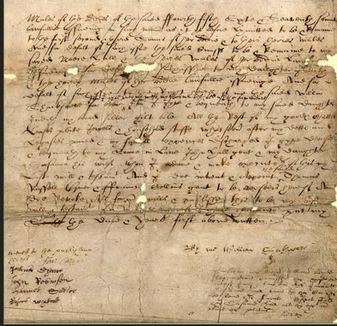
Shakspere's will page 3 1616

Signature Shakespeare legal document 1610

For some strange reasons  not a single written letter, note, manuscript, correspondence does exist for William Shakespeare (Stratford). Judging his handwriting skill we are dependent on 6 existing signatures.

Shouldn't  these few examples of a lack of motor writing skill  be sufficient to establish  - at least - a reasonable doubt that William of Stratford could have written all the immense  works of  the "Shakespeare Canon" ?.


Why do Shakespeare experts  (Stratfordians)

 think this argument is rather weak?


(424) Why Shakespeare left his wife only his "second best bed" (of his 5 residencies)?

To whom did Shakespeare 
leave his "best bed"?


Shakspere's Will, page 3:  belated insertion   to my wife " my second best bed

The fact that William Shakspere (Stratford) in his will left his wife nothing else than a bed seems to be a greater problem than the problem why only the "second best" bed. -

.....an even bigger problem is why "the second best bed"  as well as the rings to  "Heminges & Condell" (s.next blog) were inserted so belatedly in a finished text.

As long as a Shakspere  authorship problem is generally denied, very likely a more profound background of the true scribe  of  Shakspere's will (s.Blog 426) as well as the  (allegoric) meaning of the strange belated insertions  will never be discussed,  
 .


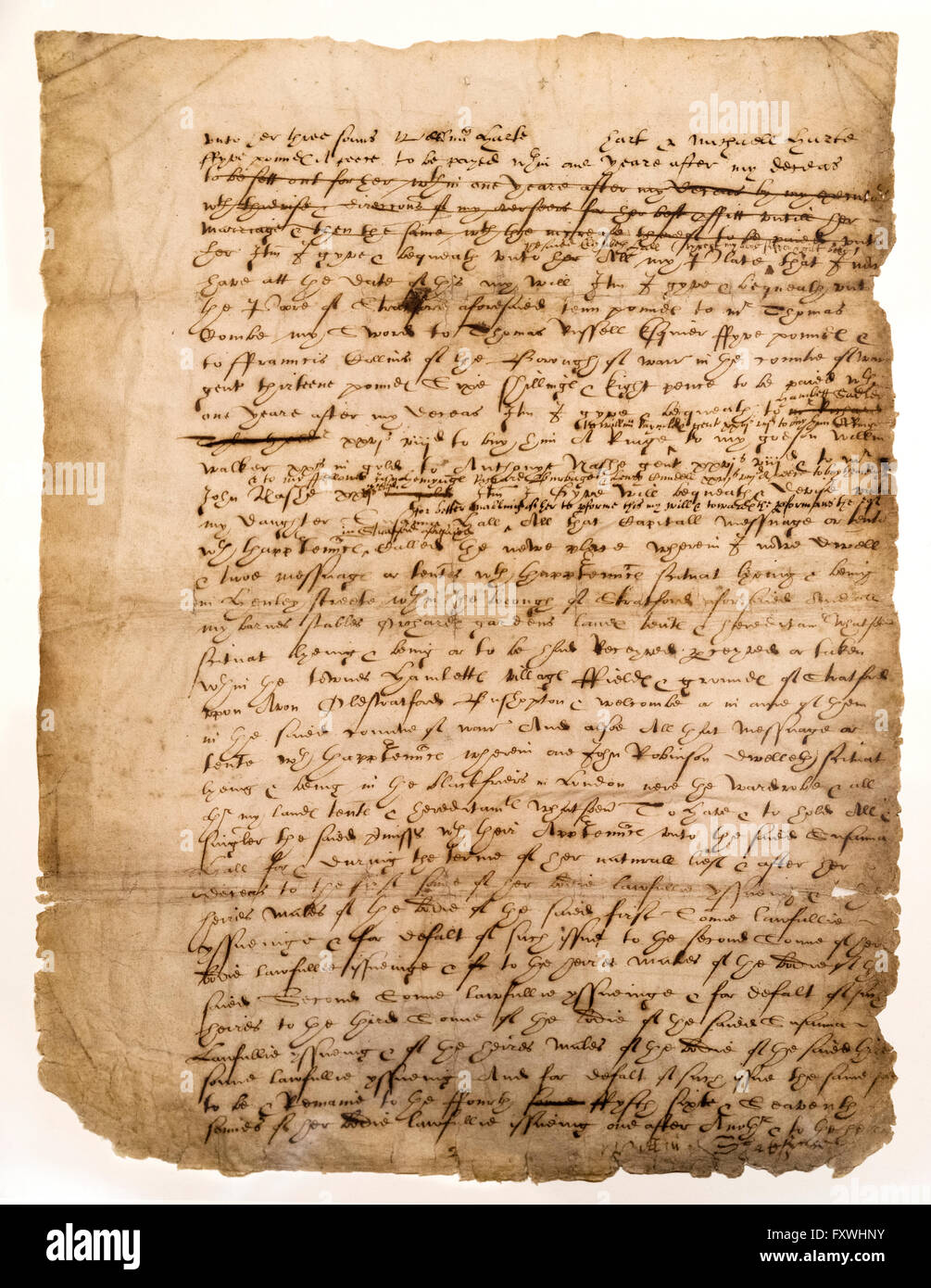
Last third page of Shaksperes Will (1616)

(423) Redat(shap)ing Shakespeare’s will ....inserted text with connections to the theater, why so late and so little ?

When and why these  late 

insertions 

(In Shakspere‘s will)  have taken place?

Bildergebnis für shakespeare's will 
Insertion into Shakespeare's will: 
"...to my ffellowes John Hemynge Richard Burbage and Henry Cundell, 26 shillings 8 pence apiece to buy them rings

The head of legal records of The National Archives (TNA- the UK government's official archive, containing 1,000 years of history") has reinvestigated  Shakespeare’s original will and  came to the  conclusion   that parts of Shakespeare's  will had to be redated .-

Page two  has been identified as a page reused from a previously unknown will, written earlier, the other two pages were rewritten in January 25, 1616, and that all three pages were slightly amended in darker ink in late March 1616.
The  three-page will is dated 25 January 1616, with January crossed out and replaced by March.

Due to new technical analysis of infrared rays and multispectral analysis, it has been concluded that the paper and ink of the three folios pages are not uniform, and page 2 (click details)  were written with different paper and ink.-
In late March a small number of additions in a darker ink were squeezed (!)  into the will at this point in time, including the change from January to March, including  the bequests of mourning rings to his friends [Heminge, Burbage & Condell  s.Faksimile], and the [second-best] bed to his wife.

Why did it never surprise Shakespeare experts  that the "ingenious superbrain" Shakespere at first completely forgot in his will to leave even a single legacy for the theater and only belatedly  squeezed between  two lines an additional line bequeathing  fellows  (Heminge, Condell) with a ring, without considering more formative figures such as Ben Jonson or Henry Wriothesley?


VIDEO LAST WILL & Testament

VIDEOS – Complete Video Archive:VIDEOS – Complete Video Archive:
OPEN  —>   Heading-->  Home -->Videos -- Shorts  -- Posts
                                                                   ->Popular

---------------------------------
OPEN  —>   Heading-->  Home -->Videos -- Shorts  -- Posts
                                                                   ->Popular

May 15, 2016

(422) The Shakespeare authorship riddle: "Oxfordianism" obviously a big obstacle for its solution?

A PARADIGM  S H I F T 
is overdue and necessary ! 

 It's highly regrettable, that Oxfordians have comitted themselves so definetely and finally!

Oxfordian Tom Regnier
1950- 2020
(† from Corona)


Tom Regnier, president at the Shakespeare Oxford Fellowship (SOF), an appellate lawyer in South Florida gave (besides earlier speeches) a fine presentation April 11 2016 at GableStage in Coral Gables Florida

Did Shakespeare really Write Shakespeare? –
Was William from Stratford able to write at all?

The basic knowledge and insights ( Regnier reports) has now circulated for almost 100 years . It has - remarkably - not led to a paradigm shift.

Whence he derives his expectations and hopes, that in another 100 years the Oxfordian case (Shakespeare was the penname of the Earl of Oxford) will be accepted general knowledge ?

Conclusion: Whereas Tom Regnier's question is fully justified (provided it is formulated more inocuous: Did Shakspere [of Stratford] really write Shakespeare [of the works] ?) his answer is not sufficiently justified.-

A paradigm shift is overdue and necessary ! 
It's highly regrettable, that Oxfordians have comitted themselves so definetely and finally!


Oxfordian Tom RE G N I E R


(421) "Shakespeare's tiresome authorship ." (A german Essay)


B R O T H E R S  in  S P I R I T

. “Marlowe and Shakespeare” – 

Position and Influence from a Historical Perspective

Author: Thomas W70 (blog)
Source: der Freitag 
2014

Content: An essay written for the 450th anniversary of Christopher Marlowe, placing him in relation to Shakespeare. The text explores the aesthetic, historical, and stylistic connections between Marlowe and Shakespeare, thereby indirectly addressing questions of  influence, and collaboration.


------------------   excerpt 1 (translated)  ------------------------

Christopher Marlowe is also celebrating his 450th birthday this year. The significance that Marlowe had for Shakespeare can hardly be overestimated and goes far beyond the obvious influences he exerted on Shakespeare’s early tragedies and histories. It was Marlowe’s personality, with its dangerous unpredictability, that had an inspiring effect on Shakespeare, giving his work decisive impulses and opening up new perspectives. Even though they were fundamentally different in temperament, they were brothers in spirit. When reflecting on Shakespeare, taking a look at Marlowe as well can be extremely helpful. Viewed from this three-dimensional perspective, Shakespeare emerges much more vividly within a historical and aesthetic context.

-------------------   excerpt 2  ( translated )---------------------

His [Marlowe's] enormous self-confidence was by no means without justification. He was endowed with genius: his first play, Dido, Queen of Carthage, which he probably wrote at not yet twenty for a company of boy actors, already displays an impressive assurance in conception and in verse. His first play written for the public stage, Tamburlaine the Great, was an immediate sensation, and from then on success was his constant companion.


------------------------

Personal C o m m e n t a r y:

It is difficult not to find it regrettable—and indeed astonishing—that the author, despite the situation outlined, appears never to have encountered the long-standing scholarly debate surrounding a Marlowe–Shakespeare authorship controversy.


---------------------------


May 11, 2016

(420) Hand written poem discovered pointing to the "true" authorship of Shakespeare...

Newly discovered FIRST FOLIO

with an altered (exchanged)  left page1 
To the Reader ( handwritten Poem)
compared to Jonsons POEM

--------------------------------------------

..he lost the Fame, which he had gain'd before

(line 4)


Newly digitized First Folio with  2 handwritten Poems, a) "To the Reader" of Ben Jonson and  below b ) of an unkown writer (s.above))

On the occasion of Shakespeare’s 400th  anniversary a Website “Shakespeare Documented"  recently has been launched  offering a great collection of  primary-source materials documenting the life and work of William Shakespeare (1564-1616).

There you find a  newly digitised First Folio (s.Faksimile). The opposite page to the Title page
 (-->the famous Droeshout engraving) is missing. Normally it exhibits  Ben Jonsons Poem “To the Reader”,

 instead you find a handwritten copy of Ben Jonson first folio  poem  together with a handwritten poem directly above it, of which the headline has torn out. (s.above)

Ros Barber has pointed out on her web-site that one will not be able to  understand or interprete the poem unless one considers the Marlowe/alias Shakespeare authorship thesis.

The meaning of the poem is deliberately veiled.   The most revealing lines 4-6  tell us that  the shepheard [Marlowe] lost his fame which he had gained before, he was permanently forced to surrender and strove in vain – and  emphasised in italics(!) he had excelled himself  (sounds a bit like had „exiled himself“).


(419) An clairvoyant early vision of the "Shakespeare problem"

 A L E X A N D ER    D Y C E 

 "if every old tragedy of more than usual merit, whose author is either doubtful or unknown, must be fathered' upon Marlowe, the catalogue of his [Marlowes] dramas will presently be swollen to a size, not easily reconcilable with the shortness of his life."

_________

Alexander Dyce "The Works of Marlowe" 1850
Alexander Dyce (1798 – 1869)  Dramatic editor and literary historian, an  early  biographer of Christopher  Marlowe in 1850 published 
                   --->"The Works of Marlowe 
with some account of the author, and notes".  In his chapter "Some account of Marlowe and his Writings" he concluded with 2 amazing prospects:

1.) It has been objectured that both "Locrine" and "Titus Andronicus" are by him:  but, if every old tragedy of more than usual merit, whose author is either doubtful or unknown, must be fathered' upon Marlowe, the catalogue of his dramas will presently be swollen to a size, not easily reconcilable with the shortness of his life.

2,
)
...that he[Marlowe] displays the vast richness  and vigour of his genius. But we can hardly doubt  that if death had not so suddenly arrested his career, he would have produced tragedies of more uniform excellence; nor is it too much to suppose that he would also have given still grander manifestations of dramatic power. 

Indeed for my own part, I feel a strong persuasion, that, with added years and well-directed efforts, he would have made much nearer approach in tragedy to Shakespeare than has yet been made by any  of his countreymen.
_____________

In 1850 Marlowe expert Alexander Dyce seems to have been clearly ahead of his time!  

But yet there was   an insurmountable   barrier  to recognize "Shake-speare" as a pseudonym / penname  of the incomparably productive Marlowe since he was murdered  in a dispute over the payment of a bill exactly at the time of his greatest threat to life by the church and state.


------------------------------------------------
VIDEOS – Complete Video Archive:
OPEN  —>   Heading-->  Home -->Videos -- Shorts  -- Posts
                                                                   ->Popular


May 10, 2016

(418) The unimaginable (never noticed) revelations of the "true" Shakespeare: B.Griffin ,"Fidessa" part 5

(417) The unbelievable confessions of the true Shakespeare: B.Griffin in "Fidessa" Part 4

                      F I D E S S A  (4)

—————————————-

                         Griffins sonnet cycle 


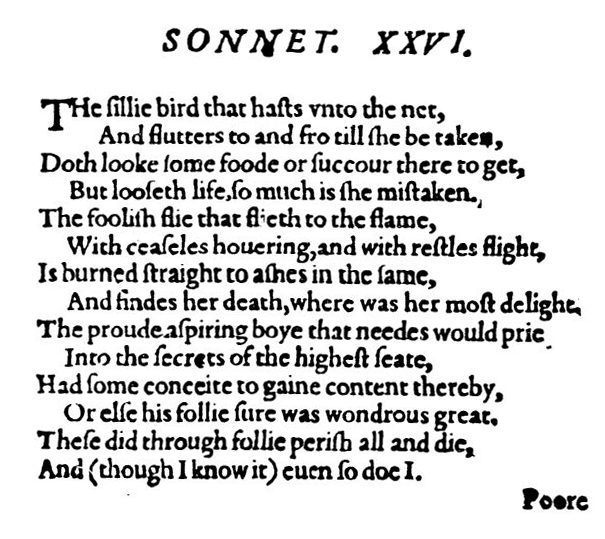
Sonnets 13 and 26  both deal with the  autobiographic theme of its author

  ( Marlowe/ alias Shakespeare) who did expose himself  with lethal risks he had not foreseen.

________________________               s.Video below!         ____________________________

I die to live in care (XIII)

These did...perish all and die, ...
and even so doe I. (XXVI)

Sonnet 13

Sonnet 26


Sonnets  13 and 26 have nothing to do with "Amatory sonnets". Identically they both deal with the same autobiographic theme of its author  who did expose himself  with lethal risks he had not foreseen. He defends himself against the accusation of his lack of fidelity /loyalty.

He ambigously argues with his inner opposite, his virtue /his Queen. One can assume with considerable plausibility, that the author (Marlowe/alias Shakespeare) sees himself metaphorically in the mirror.

- Sonnet 13 -  the foolish Boy that did aspire  to touch the glory of hihg heavens Frame, compare me to Leander struggling in the waves, not able to attain his safety's shore

- Sonnet 26-   the proud aspiring Boy that needs would pry into the secrets of the highest seats, had some conceit to gain content thereby  or else his folly sure was wondrous great


Superficially the  last 2 lines in sonnet 13 and 26 differ, they disclose the matured art of Marlowe's (alias Shakespeare's) remarkable verbal dexterity,  his incomparable astute use  of  ambiguity and ambivalence ..


(416) How devastating the Academic Stratford Dogma has misguided literary studies.: B. Griffin, " Fidessa" part 3

                            F I D E S S A  (3)

——————————-

                             Griffins sonnet cycle 


Fidessa" as a prime example 
of how devastating the academic Stratford dogma  
has misguided literary studies ..(s.video below!)

1  I hide

2  my head

3 a)my face /
   b)no face


4  I live
    a) alone /
    b) as I were
         dead

Last part of Sonett 33 (Fidessa) 1596
The 62 sonnets  of  Fidessa by B.Griffin (1596) represent a remarkable rare piece of poesie.

Apparently at present only a single exemplar in the Bodleian Library does exist! It is not certain, that the prename "B." of "Griffin" was „Bartolomew“. Alexander Grossart in 1876 published  a first reprint (50 private copies ). He regretted he could add  nothing to the poets empty life and biography, since  every probable source of information has been explored without success. All information we have is Fidessa, a small volume of "Amatory Sonnets",  as Grossart called it.

All 62 Sonetts  of the poem cycle "Fidessa" can and must be seen as a continuous poetic confrontation between the author himself  (concealed Marlowe/ alias Shakespeare) and his destiny.

Various sonnets of "Fidessa" have been identified as  putative "plagiarisms" of other authors: The third sonnet in Fidessa, beginning "Venus and yong Adonis sitting by her", was reproduced in 1599 in "The Passionate Pilgrime" (by W. Shakespeare), the Sonnet 35/39 in "Delia"  (Samuel Daniel) .


Sonnet XXXIII (33 s.Faksimile ) clearly illustrates the situation of the author (Christopher Marlowe/alias Shakespeare). As in Shakespeare's sonnets  the author  uses the method of repetition (doubling)  of specific word to highlight the contextual importance:

 He has to hide(1) his head (2) and live (3) alone as if he were dead, with  no identity,  no face(4)

The poem  of  "Fidessa"  clearly needs a theory of who was the author  providing us with an explanatory framework for its interpretation.

 The "Stratford Dogma"  had catastrophic consequences, since it  blocked all ideas  to approach an authorship solution!
_____________


——-


415) The incredible revelations of the "true" Shakespeare: B. Griffin. Fidessa Part.2


                             F I D E S S A  (2)

Significant  biographical informations in Fidessa should lead to the  conclusion that the name “Griffin” (a fabulous animal having the head and wings of an eagle) 

                      was used as  Marlowe/alias Shakespeare's  pseudonym.

s.Video below!

_______


A certain B.Griffin wrote  a“ little volume of Sonnnets”, a series of 62 poems entitled “Fidessa, more chaste than kinde, London”, 1596.  

No trace of a poet B.Griffin has ever been discovered over centuries.

To obtain biographical information of Griffin, we are dependent on the contextual information extractable from Fidessa..

What conclusions can we derive from Fidessa?  

“Fidessa” is an artifial word derived from

a) “fides” (faith, confidence , trust in a person or thing – or an obligation of loyality, or fidelity to a person,  a promise, or an engagement) and

b)"...essa", a female ending thus transformed into a metapher of a female subject / godess, with which the poet enters a dialogue .-This is reminiscent of the philosophy of Shakespeare e.g. in "The Twelfth Night" (II / 5), ("Put thyself into the trick of singularity. She [as his virtue] ran thus advise thee that [she] sighs for thee").
  
The situation of  the author clearly indicates that the author is and has been in a most dangerous,  vexing and conflicting life situation of loyalty and confidence. The poems surpass Shakespeare's sonnets in some places in its poetic brilliance and contain substantial  biographical notes on the authors  specific situation: 
Significant  biographical informations in Fidessa can hardly lead to any other conclusion than that the name “Griffin” (a fabulous animal having the head and wings of an eagle) was used as  Marlowe/alias Shakespeare's  pseudonym. This can be recognised in virtual all  sonnets :(s.examples  subsequent. blogs)

Ai  Video Dialog (by NotebookLM)

on the ORIGINAL VIDEO     (below !)


O R I G I N A L - VIDEO


May 08, 2016

(414) The Shakespeare authorship theory is falsely rejected...... ["Fidessa" part 1]

                            F I D E S S A  (1)

—————————
Griffins sonnet cycle  


... a coherent interpretation. 


A certain B.Griffin wrote  a series of 62 poems entitled “Fidessa, more chaste than kinde, London”, 1596./ (“little volume of Sonnnets”). 

Initially there is a dedication “To the Reader” entitled  “To the gentlemen of the Inns of Court”, from which it can be inferred that Griffin himself had some sort of relations to the Inns of Court, but no trace of him has ever  been found in the registers.
Of  an  English poet B.Griffin  virtually nothing is known up to now beyond a single "poetic masterwork", the sonnets of "Fidessa"  (s.Faksimile title  1596.)

There are highly conspicious  inconsistencies, which have never be explained adequately:  Some examples:


1.) Why there  exist virtually no biographic traces of B. Griffin in England?

2.) Is it reasonable to think that such a highly gifted poet did  write only a singular  literary work?


3.) Why "Fidessa" is seen by high  ranking Shakespeare experts  (Prof.W.Koppenfels, personal   communication) as "third-class" amatory sonnets of minor Elisabethan poets?


4.) Why no literary expert ever tried or succeeded, to assign the contextual contents of "Fidessa" to a specific contemporous author and his biographic situation?


5.) Is it reasonable to think that  the poet Griffin was able to write his very first literary work ("first fruite of any my writings") already at that high level of  poetic artistry?


6.) How can it be that  Sonnet 3 of  Fidessa (1596) beginning "Venus and young Adonis sitting by her"   also appeares as Shakespere's first work (op.1) as well as a Sonnet in The "Passionate Pilgrim" , 1599?


7.) What may have been the motiv of Shakespeare (whoever the author was!)  to significantly  alter the lines 9-13 of Griffins Fidessa (1596)   in "The Passionate Pilgrime"(1599) 
                                                            s.Blog 494)

8.) Why Shakespeare can be clearly identified as the author of "The Passionate Pilgrime [s.Faksimile] on the title page",  but other  identified authors such as B.Griffin, C.Marlowe or R.Barnfield are not mentioned?

________________________

The at present most plausible explanation for the total failure of the "Academic Shakespeare Expertise", to search for a consistent theory of these bizarre "Fidessa" observations, lies in the fact, that the most logicall thesis was rejected from the beginning: The Marlowe/alias Shakespeare Thesis : a covert "false flag" operation of the English Crown and State helped to feign Christopher Marlowe's death for life-saving reasons

During his concealed "second" live he accepted to write under a multiplicity of pseudonyms /pennames such as Griffin, Barnfield , Shake-speare and so on!)
_______________


Ai  VIDEO - DIALOG
on

The Original VIDEOS       (1 &2)


 O R I G I N A L --V I D E O- 1


O R I G I N A L --V I D E O- 2 


May 03, 2016

(413) Diana Price did not tackle the actual necessary step of the Shakespeare authorship problem,

Diana Price "scientifically" involved 

in unveiling the "false" Shakspere… 

but…

…not in revealing the "true" Shakespeare.  - Inexcusable!    

Both problems belong intrinsicly together....  and should be answered together!

----------------------------------
....She didn't dare to imagine the unimaginable:   that a multiplicity of contemporary poet names were pseudonyms or pennames (e.g   Wither , Cary , May, Davenant Sylvester, Drayton, Beaumont , Fletcher , Heywood , Shakspeere , Massinger...)

of the single poet geniius ,"true" Shakespeare.  


Diana Price: Unorthodox Biography"

Some of the true Shakespeare's pennames
In George Wither." The Great Assises " 


Diana Price, author of the book  "Shakespeare’s Unorthodox Biography: New Evidence of an Authorship Problem", gave a lecture (s.video) on the occasion of the 400th anniversary of Shakespeare of Stratford’s death , at the Berkeley Street Theatre in Toronto.

Historically the Shakespeare authorship problem never felt obliged to proceed to the second step researching the actual question:” Who did it, [if not William of Stratford].?

Only a minor community of intellectuals, sceptics, scholars (Non-stratfordians) entered the second stage. One of todays best known „Non-Stratfordian“ scholars is Diana Price. Her research adds to longstanding conclusions that William Shakspere of Stratford by no means can have been identical with William Shakespeare, the creator of Hamlet. -

Interestingly Price has never aligned herself ( as far as I can see)  with any one other possible candidate, even though she got  this far into the authorship issue.  Unfortunately she  nevertheless   did never privilege one candidate over another.

Her website tells that she has been invited to all "Oxfordian"  conferences, but she doesn’t go because she does‘t want to be perceived as favoring one particular candidate over another . She generally doesn’t take questions on the case for or against Oxford, or Bacon, or any of them. When she is asked , „Was it Shakespeare or was it Oxford?" she frames the question differently "Was it Shakespeare or was it not Shakespeare?"

That is remarkable.- One wonders.....


...why at her  absolute certainty of the first stage  (that William of Stratford was not the creator of Hamlet) , she never  seem to have felt the need to enter the second stage?

How can Diana Prize expect that a yet unknown poet can be discovered from oblivion?  the answer to the first stage seems easy (considerung the immense collective efforts done )  compared to the answer of  the second stage. – 

The problem is not the "false William" but the "true"!
 
Without solving the Authorship problem as a whole 
all hollow words!
------------------------------------

Diana Price

Shakespeare's Unorthodox Biography


(412) The ridiculousness of Shakspere's authorship disclosed! (Professionally made Video , part 1)

Richard A. Wagner 

Baconian 

…has announced to produce a  4-part TV series which delves into the Shakespeare Authorship Issue .

study V I D E O  (part 1) below!!
_________________


Based on his  book  “The Lost Secret of William Shakespeare” [ freely available online] Richard Allan Wagner has started to produce a  4-part TV series which delves into the Shakespeare Authorship Issue .

The professionally made part 1 now available, exposes well known facts and arguments why there is not enough evidence to support the traditional claim that William from Stratford was involved with the authorship of the plays and poems attributed to the name "William Shakespeare".

One can fully agree with the arguments of Video Part 1  “Exposing the Shakespeare conspiracy“ which enlightens us who the author was not!!!.-

Wagner   summarizes  all  the  evidence (developed over a century), that William of Stratford can not have been the author of Othello or Hamlet.

Since Rick Wagner is a „Baconian“ and a Freemason , I am afraid, that the (promised) upcoming parts are not as easy to digest, …but already now its certain that - beyond all cypherology - the "true Shake-speare" was an influential forerunner ("predecessor") of  Masonic philosophy.

Exposing the Shakespeare 
Conspiracy  part 1.


Exposing the Shakespeare 
Conspiracy  part 2.