January 05, 2016

(367) 2 Steps of Questioning Shakespeare’s Authorship

K E I R.  C U T L E R. ( 5)

2 C O M P E L L I N G   C O N S E C UT I V E
steps of questioning the Authorship:


the Shakespeare authorship debate should always be 
divided into  2 consecutive steps of questioning:

1.) Is William from Stratford   the "false" Shakespeare ?

If yes.....

2.) 
Who  may be  the "true" one ?

The first step results from  the (ever since) increasing doubt  that the Stratfordman William Shakspere could not possibly have been the author William Shakespeare who wrote „Hamlet“, „King Lear“ or „Loves Labours Lost“

The doubts  developed gradually with the discovery of an ever increasing number of bizarre theories (such as: Shakespeare The Collaborator) because of too many unanswerable questions .

(Click   the TOP 10 of Cutlers and Emmerichs questions, - True, but a bit too old worn-out  - in my opinion- , compared to the   Main Reasons ! 


The Reasons  of

 "Keir Cutler

and 
"Roland Emmerich"

to doubt the Shakspere Authorship

Many more of these questions were early adressed by a remarkable group of human beings (artists, intellectuals, scientists, teachers, actors, free thinkers etc. termed 
Non- or Anti-Stratfordians")
 over time …. ideas, thoughts and documents of these  independent thinkers  have  infected many people  for too long,  their illness is no longer curable...

       ( the "Red Berets" or Oxfraud - still consider  Non-stratfordians as a bunch of Idiots...)...
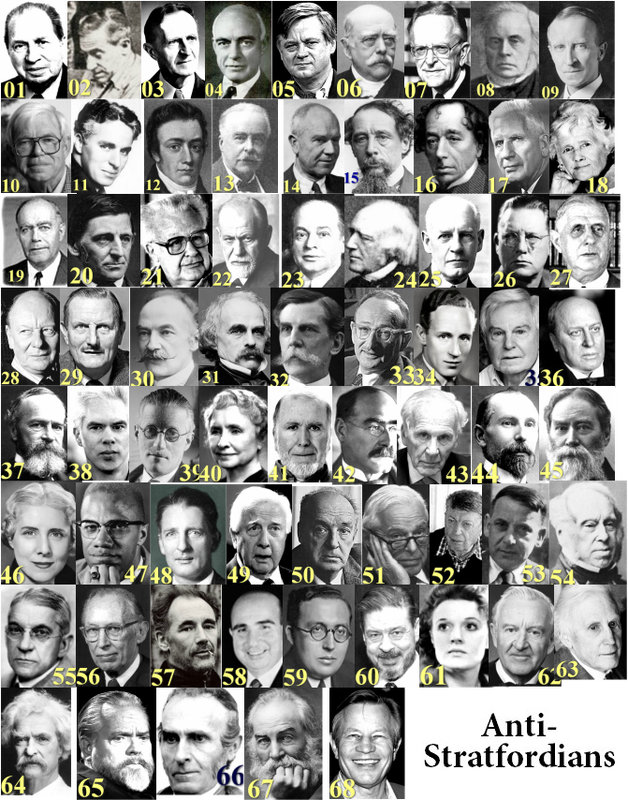
A tiny selection of Shakspere Doubters [Anti-Stratfordians]:
1,   2,   3,   4,   56,   7,   8,   9 
10,  11121314,   1516,  1718,
19,  20,   21222324252627,
2829,  30,   31,  32,  33,   34,  3536
3738394041,  42434445,
464748495051525354,
555657585960616263,
6465666768 .-   

Historically,  the second step and (re)search („If is was not the Stratfordman, who was it ?“)  wouldn’t have taken place without the first ..-

Since Stratfordians denied  to take the first step they more or less had to declare the Non-stratfordians with all their arguments and critical thinking (conscious and unconscious) from the beginning as truthers or conspiracy theorist …that is to say as mad or crazy people.

The spearhead of the Stratfordians, the  "Red  Oxfraud Berets", or "Orthodox "Ant-Anti-Stratfordians", an interesting microscopic group of a mentally armed "Special  Stratfor(d) Task Force" of cloaked intelligence with their unofficial warrior diplomats (Mike Leadbetter, Tom Reedy, [his favorite word is "Pissing"] Mark Johnson, Nemo Whilk etc ) draw a clear position  on their Webpage:

"Any person with a studied view of the debate knows that the case for Shakespeare is solidly documented in the historical record. What we're interested in is .......why anti-Stratfordians deny that record. We're not here to give each other high-fives."

It is astonishing (more than refreshing) to observe the  Oxfraud "Red Berets" most often feeling seemingly in a joyful  superior position compared to  the ineradicable group of  old fogeys Anti-Stradfordian....,


https://www.youtube.com/watch?v=dkx7ChWkRvc


December 21, 2015

(366) The advantages of the uncertainty principle in Shakespeare’s Authorship.

R O S  B A R B E R (4).

For inner-tactical reasons seems to have mutated  from a "hard  Marlowian" to a "soft Agnostic".-

Ros Barber
Modified from a Cartoon of S.Harris


Towards the end of 2013 I was convinced that "Marlowian" Ros Barber (PhD) had begun to  courageously resist the academic Shakespeare authorship Taboo sustained for centuries (s. Blog 65 )
But 2 years (2015) later  I had to change my mind (s.
Blog 343.) I assume she only got his new position as a Lecturer in Creative and Life.  Writing at Goldsmiths, University London on condition that she was mutating from a "hard  Marlowian" to a "soft Agnostic".- This would make sense, having read the Abstract of her speech at this years (2015) Oxford-Shakespeare Authorship Conference  September 24-27 in Ashland.-

According to her abstract and an interview to a local radio Station (s.
Blog 343.Listen!) she must have given up her earlier opinion and is now favoring 

the value or benefits of  the  uncertainty principle. - 

The abstract tells us that it will explore the benefits of uncertainty of the Shakespeare authorship:
  1. „it not only allows us to be collegial, (s. "The unfaire Lady...." Blog 322)  reducing the likelihood of stressful and energy-sapping personal battles, but by opening our minds to evidence and counter-arguments which undermine our position it allows us to discard weak arguments and concentrate on those which extend and deepen the challenge to orthodox thinking
  2. „…it  also offers non-Stratfordians the possibility of gaining academic legitimacy for the Shakespeare authorship question. Using concrete examples of arguments and counter-arguments derived from researching and writing Shakespeare: 
  3. The Evidence, this paper will demonstrate why the apparently ‘weak’ position of uncertainty is actually the strongest, most beneficial position a non-Stratfordian can adopt.“

In quantum mechanics, the uncertainty principle, is any of a variety of inequalities asserting a fundamental limit to the precision with which certain pairs of properties [of a particle], known as complementary variables, such as (Academic) position x and (Marlowian) momentum p, can be known simultaneously.

                                     
 Ros Barbers Praise  of  'her' Uncertainty
on MARLOWE as true SHAKESPEARE(?)


December 20, 2015

(365) The multiple Co-authorships of Shakespeare: A great literary hoax ...

 ‘C O - A U T H OR S H I P 

or the nature of C O L L A B O R A T I O N 

Or the GROUP-Theory

    Prof.William Leahy


Prof.Brian Vickers


Anti- stratfordian Prof. Bill Leahy
 favorizes the   Co-Authorship- or GROUP-Theory

For over two centuries scholars have discussed the possibility that Shakespeare worked with Co-authors on several plays, because certain plays showed significant signs of a putative collaboration with other writers. 

Shakespere experts such as Brian Vickers believe that Shakespeare wrote

"Titus Andronicus" together with George Peele,
"Timon of Athens" with Thomas Middleton,
"Pericles" with George Wilkins, and
"Henry VIII" and "The Two Noble Kinsmen" with John Fletcher. --

Also other  plays such as "Sir Thomas More"(Primary Author A.Munday)  or "The Spanisch Tragedy"(Thomas Kyd) contain additions indicating a collaboration with Shakespeare. What type and nature  of collaboration  was this between the dramatists?

Was it an interactive collaboration  or an ex-post-facto revision?

The plays that have been suggested as being co-authored are largely at the beginning and end of the canon and are  viewed as apprentice pieces (early plays) and unfinished works (late plays).

                     
Has anyone ever thought about the ways how such a collaboration with the outstanding extraordinary Shakespeare could have taken place and why there does not exist a single independent historical source for personal connections between one of those alleged collaborators and Shakespeare?
Isn't the inverse idea and theory  more likely and logical, that  Shakespeare's co-authorship did not result  from a collaboration with different authors but from his "own" singular unique authorship, being forced to write and invent under different pennames or pseudonyms throughout his life, as proposed and developed in the Book(summary)


Multiple Co-authorship versus Multiple Pseudonymity

"The true Shakespeare:  Christopher Marlowe.
(engl. Summary of the book)


https://www.youtube.com/watch?v=CtUv87BoDGY


December 19, 2015

(364) A metaphoric Blueprint of the the Shakespeare Authorship

A  F U N E R A L  E L E G Y  
Unbelievable, but….
  in reality an Allegoric Poem 
on TRUE SHAKESPEARE(=Marlowe)

s. also Blog 214 ,   ->Blog 260    ,  -> Blog 348  ,    ->364

_______________

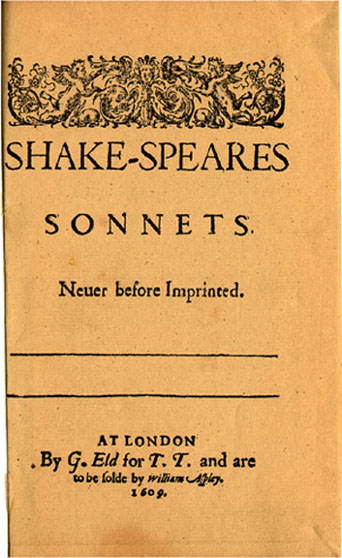
„The Funeral Elegy“ (1612 with 578 lines [abab], printed by Thomas Torpe (T.T.), who edited »Shake-speares Sonnets«[1609])  obviously must be recognized as a poetic [allegoric] blueprint of the hidden destiny of the "true Shakespeare" (W.S.), Christopher Marlowe.-

——> BOOk-SUMMARY (Marlowe/Shakespeare Theory)

Nobody can expect us to believe, as postulated, that W.S. (William Shakspere) or John Ford dedicated these lines (in print 19 days  after the murder) to the brother of unknown William Peter, deadly stabbed into the head
 (!! corresponding to Marlowe's alleged fate .)
See also authorship debate William Niederkorn NYT 2002).-

 The Elegy can (and must?) be interpreted as a continuous allegoric self-presentation or self-portrayal of the fate of the author.- I see no alternative other than  to interprete the subsequent remarkable lines as an allegory to Marlowe's concealed destiny: they seem to need no further explanation or interpretation.-.

"Stratfordians" ("Oxfordians" or even  worse:"Oxfraudians") will, however, never reach any conclusion, since they are not  ready to accept the  Marlowe/Shakespeare theory , at least as a working hypothesis with the assumption that ...-


Marlowe survived and wrote under multiple pseudonyms such as Shakespeare or Ford.-

                                                                              For details s.Video!


____________________

Each of the following  single  lines elected  (numerated) more or less are indicative for a singular

 "autobiographical evidence (correspondence)" of Marlowe's destiny, life, thoughts or philosophy.- 

Who else, in 1612, could be meant or could fit with the stuning textual contents of  these  lines?

Excerpt of a Funeral Elegy«  
of  W.S.(1612) 
[Line Numbers correspond to lines of the Funeral Elegy]

  5  What memorable monument can last
      whereon to bild his never-bleemished Name
  8  oblivion in the darkest day to come
10  cannot rase out the lamentable tomb  
101 for his becoming silence gave such grace
139 my country's thankless misconstruction cast
      upon my name and credit,both unloved
145 yet time, the father of unblushing truth
      may one day lay ope malice which hath crossed it
159 For should he lie obscur'd without a tomb,
195 What can we leave behind us but a name,
  Which, by a life well led, may honor have?
      Such honor, O thou youth untimely lost,
207 My love to thee, which I could not set forth
     In any other habit of disguise.

210 To speak the language of a servile breath,
     My truth stole from my tongue into my heart,
    Which shall not thence be sund'red but in death.
215 But that mine error was, as yet it is,
    To think love best in silence: for I siz'd thee
223T' enlarge my thoughts was hindered at first,
    While thou hadst life; I took this task upon me,
    To register with mine unhappy pen
    Such duties as it owes to thy desert,
     And set thee as a president to men,
     And limn  thee to the world but as thou wert-
     Not hir'd, as heaven can witness in my soul,
231 Nor servile to be lik'd, free from control,
     Which, pain to many men, I do not owe it.
 237 But that no merit strong enough of mine
     Had yielded store to thy well-abled quill
     Whereby t'enroll my name, as this of thine,
240 How s'ere enriched by thy plenteous skill.
     Here, then, I offer up to memory
     The value of my talent, precious man,
     Whereby if thou live to posterity,
     Though't be not as I would, 'tis as I can:

293  He was not so: but in a serious awe,
      Ruling the little ordered common-wealth
      Of his own self, with honor to the law
341 Most unjust choler, which untimely Drew
      Destruction on itself; and most unjust,
     Robb'd virtue of a follower so true

369 to conquer death by death, and loose the traps
       He thus, for that his guiltless life was spilt
       by death, which was made subject to the course
423 T Grave-that in his ever-empty wombhe
       Forever closes up the unrespected
      Who, when they die, die all-shall not entomb
      His pleading best perfections as neglected
483   Look hither then, you that enjoy the youth
       Of your best days, and see how unexpected
        Death can betray your jollity to ruth
        When death you think is least to be respected!
        The person of this model here set out
492  Of his humanity, but could not touch

       His flourishing and fair long-liv'd deserts,
       Above fate's reach, his singleness was such-
       So that he dies but once, but doubly lives,
       Once in his proper self, then in his name;

499 And had the Genius which attended on him
   Been possibilited to keep him safe

   Against the rigor that hath overgone him,
   He had been to the public use a staff    [speare or shaft of a spear]
   Leading by his example in the path
 535 His due deserts, this sentence on him gives,
    "He died in life, yet in his death he lives."
564 Before it may enjoy his better part;
    From which detain'd, and banish'd in th' Exile

                        ________________
A variation on a recurrent pressing problem 
________________________________________________
The Marlowe Authorship Theory  recognizes the name „William Shakespeare“ (W.S.) as a pseudonym, deadly threatened  Marlowe borrowed (for safety reasons) from the living Stratford business man in 1593.


-----------------------------------------------------
VIDEOS – Complete Video Archive:
OPEN  —>   Heading-->  Home -->Videos -- Shorts  -- Posts
                                                                   ->Popular

December 18, 2015

(363) the Shakespeare authorship and circumstantial evidence

TOM  R E G N I E R 

The validity of circumstantial evidence

________________
Tom Regnier
1950-2020

One can be almost certain that the Shakespeare authorship question ["Was Shakespeare of Stratford a front to shield the identity of the real author?“] has not been resolved once and for all  -

Fine Shakespeare Oxford Fellowship (SOF) president  Tom Regnier (who unfortunaly died from the CORONA Virusdiscussed the general problem of direct and circumstantial evidence  at this year’s SOF conference in Ashland, Oregon .(->.Video see below!)


On its own, circumstantial evidence allows for more than one explanation. Different pieces of circumstantial evidence may be required, so that each corroborates the conclusions drawn from the others. Together, they may more strongly support one particular inference over another. An explanation involving circumstantial evidence becomes more likely once alternative explanations have been ruled out.


Wikipedia: “A popular misconception is that circumstantial evidence is less valid or less important than direct evidence. Direct evidence is popularly, but mistakenly, considered more powerful.


Many successful criminal prosecutions rely largely or entirely on circumstantial evidence, and civil charges are frequently based on circumstantial or indirect evidence. 
University of Michigan law professor Robert Precht said:

 "Circumstantial evidence can be, and often is 
much more powerful than direct evidence."

Indeed, the common metaphor for the strongest possible evidence in any case—the "smoking gun"—is an example of proof based on circumstantial evidence. Similarly, fingerprint evidence, and many other examples of contextual evidence that support the drawing of an inference, i.e., circumstantial evidence, are considered very strong possible evidence.

In practice,
circumstantial evidence can have an advantage over direct evidence in that it can come from multiple sources that check and reinforce each other. Eyewitness testimony can be inaccurate at times, and many persons have been convicted on the basis of perjured or otherwise mistaken testimony. Thus, strong circumstantial evidence can provide a more reliable basis for a verdict.


Within  the —> Marlowe-Shakespeare Book a thousand(!) of circumstantial] evidences ["contextual evidences" by the majority,  but many other evidences as well] will be dealt with  that the name of a  real existing human businessman William Shakspere  (Stratford)  has been taken as a nom de plume (pseudonym) for deadly threatened Poet Genius and Superstar Christopher Marlowe in 1593 in order he could survive, change identity, live incognito  und write  under a multiplicity of pseudonyms (besides Shake-speare).-Read impressive example of 


 Circumstantial [contextual] Evidence in the SUBSEQUENT BLOG 364 


                                                     ______VIDEO _________

--------------------


https://www.theshakespeareunderground.com/the-law-in-hamlet/


December 17, 2015

(362) Thomas Beard and the Shakespeare Autorship controversy.

T H O M A S   B E A R D 

Circumstantial Evidence:

and Marlowe: 

"men of greatest name, ...be quite extinguished......smothered  and kept under ....not show it head anymore in the worlds eye...) 


_________________
4 years after Marlowe’s supposed death (May 30 1593) a highly educated „Thomas Beard“ with an incredible large "World Knowledge“ wrote in his »The Theatre of God’s Judgments (1597)

    for the first time a report on Marlowe‘s death!:   

»Not inferior to any of the former in Atheisme & impiety, and equall to all in maner of punishment was one of our own nation, of fresh and late memory, called Marlin, by profession a scholar, brought up from his youth in the Universitie of Cambridge, but by practice a play-maker, and a Poet of Scurrilitie, who by giving too large a swinge to his own wit, and suffering his lust to have the full raines, fell (not without just desert) to that outrage and extremitie, that he denied God and his sonne Christ, and not only in word blasphemed the Trinitie, but also (as is credibly reported) wrote books against it, affirming our Savior to be but a deceiver, and Moses to be but a conjurer and seducer of the people, and the holy Bible to be but vain and idle stories, and all religion but a device of policie. 
But see what a hooke the Lord put in the nostrils of this barking dogge: It so fell out, that in London streets [erased in the Edition 1612) as he purposed to stab one whome hee ought a grudge unto with his dagger; the other party perceiving so avoided the stroke, that withall catching hold of his wrist, he stabbed his own dagger into his own head, in such sort, that notwith­standing all the means of surgery that could be wrought, he shortly died thereof.«

There is hardly ever taken into account that Thomas Beard  explicitly concluded his reflections (in Booke 1, Chap. XXIII. Of Epicures, and Atheists on Marlowe) by referring to Marlowe's extinction of his identity


(men of greatest name, ...be quite extinguished......smothered  and kept under ....not show it head anymore in the worlds eye...) 

In subsequent editions (1612, 1618, 1631, 1642, 1648) Beard‘s striking "insider knowledge" about Marlowe was complemented by significant contents ("... having been in high places of favor in former times, are falling like Lucifer from Their heaven, that is, their wordly felicitie, and live like him in chaines of imprisonments.

"These arguments, together with poetic verses and other texts of Thomas  Beard must make us think about he may have known of an enforced anonymity of  "a yet living" Marlowe“ .?

Thomas B E A R D   belonged (most logically, considering the content of the total of his Book) to the Pseudonyms of Marlowe.

VIDEO

............................................


...................................................
VIDEOS – Complete Video Archive:
OPEN  —>   Heading-->  Home -->Videos -- Shorts  -- Posts
                                                                   ->Popular


December 16, 2015

(361)The Shakespeare Authorship controversy:


H O W  T O   P R O O V E 

a possible cover-up of a false-flag Operation 

Of  the English Crown?


In the german Marlowe-Shakespeare Book ( —-> engl. Summary ) it was not too difficult to present a thousand(!) of [circumstantial] evidences, that the name of a real existing human beeing William Shakspere (Stratford) has been taken as a nom de plume (pseudonym) for deadly threatened Poet Genius and Superstar Christopher Marlowe in 1593 in order he could survive, live incognito  und write  under a multiplicity of pseudonyms (besides Shake-speare).-

Everything, however  depends upon what you accept as reasonable circumstantial evidence?


Could you accept next Blog (Nr.362) as a [circumstantial] evidence that Marlowe could have survived?