January 12, 2016

(372) The true Shakespeare (Marlowe) fully disclosed in Shirleys "The Wittie fair one" ( 1628)


Did James Shirley Leave a Hidden Clue About Shakespeare?

_________________________________
 
John Cotgrave: The Treasury of Wit and Language 1655


James Shirley's Comedy: The Wittie faire one. 1633 brought out at Drury Lane in 1628

 John Cotgrave‘s text passages in his section „Of Burialls and Mourning“ of his book „The English Treasury of Wit and Language“ (1655) originate from Act V of the play, The Wittie Faire One“ of James Shirley (1633). It was brought out at Drury Lane  in 1628 but not printed until 1633. 

There can be little doubt that in this Act V[later sc.3?],  5 years after the First Folio (1623) the concealed destiny of „living“ Christopher Marlowe (The true Shakespeare) was disclosed. – 

The whole act V is about Mr. Fowler [alias the poet] a wild young gentleman, attending his own buriall as a living man and about  the cause and event of his living death .The author James  Shirley must have belonged to the multitude of Marlowe‘s pseudonyms.(blog564)

I am afraid that it will not be possible to understand the deeper meaning of the subsequent lines unless you are familiar with some details of the historical background and facts of the Marlowe (Shakespeare) authorship.  (Peter Farey  )

___________________________________________________________________________
The blog is summarized in this Youtube Video.

__________________________________________________________________________

You may also read  this original section of Act V .- Added numbers in brackets refer to the subsequent explanatory interpretation attached .

From the Comedy „The Wittie Faire one“ (Act V) James Shirley 1633
[– Click here]

Fowler: This is the room I sickned in, and by report dyed in (1), uhm I have heard of spirits walking with aeriall bodies, and ha(ve) been wondered at by others(2), but I must only wonder at my selfe, for if they be not mad, I’me come to my owne buriall (3), certaine these clothes are substantiall, I owe my Taylor for’em to this houre, if the divell be not my Taylor, and has furnish‘d me with another suit very like it (4)----This no magicall noyse, essential gold and silver? (5). What doe I with it if I be dead? (6) Here are no reckonings to be payd with it, no Taverne bils (7), no midnight Revels, (…) I might hope to get out of this new pittiful Purgatory, or at least know which way I came in to‘ t (8) --- what a divell doe they meane to do with me --- not too many teares Lady, you will but spoyle your eyes , and draw upon ‘em the misery of spectacles, doe not you know me neyther? (9)
Penelope: Oh Master Fowler (10)
Fowler: Ha, out wa’t, nay and the woman but acknowledge me alive, there’s some hope a me.(11)
Penelope: I loved thee living with a holy flame to purge the errours of thy wanton youth (12)
Fowler: I’me dead again(13)
Penelope: This made thy soule sue out so hasty a Divorce (14) and flee to aery dwellings, hath left us thy cold pale figure, (15) which wee have commission but to chamber up in melancholly dust, (16) where thy own wormes like the false servants (17) of some great man shall devoure thee first. (18) -
Fowler: I am wormes meate,
Penelope: We must all dye
Fowler: Woo’d some of you would do’t quickly, that I might ha(ve) company
Penelope But wert thou and that by miracle thy soule should with thy body have second marriage (19) I beleeve thou woo’dst study to keepe it a chast Temple, holy thoughts like Fumes of sacred incense houering about this heart, (20) then thou wou‘dst learne to be above thy frailties, (21) and resist the flatteries of smooth-fac’d lust
Fowler: This is my Funeral sermon (22)
Penelope The burden of which sinne, my feares perswade me, both hastned and accompanied thy death (23) (…) we must hope the best , he was an inconstant young man, frequenting of some companies, had corrupted his nature, and a little debauched him.(24)
Fowler: In all this sermon I have heard litte commendations of our deare brother departed (25), rich men do not go to the pithole without Complement of Christian burial, it seems if I had lived to have made a Will,(26) and bequeathed so much legacy as would purchase some Preacher a neat Cassocke,[soutane] (27) I should have dyed in as good estate and assurance for my soule as the best Gentleman i‘th Parish(28), had my Monument in a conspicious place of the Church (29), where I should have beene cut in a form of prayer, as if I had been call’d away at my devotion (30), and so for hast to be in heaven, went thither with my bookes and spectacles. (31) ----- doe’e here, Lady and Gentlemen, is it your pleasure to see me, though not know me (32) ? And to enforme a walking business when this so much lamented brother [WILLIAM SHAKSPERE] of yours departed out of this world, (33) in his life I had some relations to him,(34) what disease dyed he of pray? Who is his heire yet at Common Law, for he was warme in the possession of Lands (34) , thanke his kind father [JOHN SHAKSPERE], who having been in consumption sixteene yeeres (35), one day above all the rest having nothing else to do, dyed(36)

Interpretation of Act V    
Numbers   refer to specific passages of Act V.- .
   Bold italic words do occur in the play.

(1) Marlowe was stabbed to death, in a room sickned in (SOED „sickened“= felt faint with horror) and by report dyed, [first printed source 1597. Ref Thomas Beard Blog 362)

(2) There were early rumors of Marlowe‘s disappearance (e.g. He dyed of the plague, Ref Gabriel Harvey 1593)… heard of spirits walking with aeriall bodies….. have been wondered by others

 (3) In order to save Marlowe’s life, his death had to be faked and he had to write under new identities or pennames [such as Shakespeare], thus he was able [1616] to come to my own faked buriall in Stratford
 [but I must only wonder at my selfe, for if I am not mad, I’me come to my owne buriall]
 
(4) He received new identities (certaine of these clothes were substantial ) which he owed his Taylor up to this houre (1633), his Taylor was a divell (W.Cecil ) who furnished him with another suit [identity] very like it

(5)There were no miracles, no magicall noyse, all that happened was real

(6) He reflects his whilom faked situation of a murder, and what to do with the situation of being officially dead .

(7) He confesses that in reality there was no brawl [in Deptford] over no reckonings to be payd ! No Taverne bill , no midnight Revels  (s. „midnight revels“ in Midsummer Night's Dream – Act 5, Scene 1)

 (8) He reflects which way he came in his life catastrophy; for a long time he hoped to get out again of his pittifil purgatory ..

 (9) Fowler (alias Shakespeare/Marlowe) prefers the trick of singularity and put his thoughts in a dialogue with his own Muse(s) or Vertue(s) (here Penelope, the metaphor of his faithfulness), (Remember: »Put thyself in the trick of singularity. She thus advise thee that [she] sighs for thee! [ Shakespeare: Twelfth Night or What you will (II/5)].  Fowler/Marlowe] argues with his superego (Penelope)   Not too many teares Lady . you will spoyle your eyes … and draw upon ‘em the misery of spectacles, doe not you know me neyther
 
(10) Master Marlowe , he had his master degree

 (11) Penelope ( His own virtue / his High-selfe) acknowledges him alive he sees some hope for himself

 (12) But his High-selfe Penelope warns that he, who lived with a holy flame, had to purge his errours of his wanton youth
 
(13)This brings him back to reality : he is dead (again)

 (14)He realizes that his soul too hasty sued out a Divorce  between body and soul, it was premature to change his identity)

 (15) and that rumours (airy dwellings) spread and reported about his dead cold pale figure

 (16) Others  who had been commissioned by the crown (W.Cecil) to arrange Marlowe’s sad melancholic passing in a chamber ( to chamber up in Melancholly dust)
 
(17) where false servants [secret agents Pooley, Skeres, Frizer, ]

(18) of some great men (W.Cecil, T. Walsingham), which had  at first, to devour himself, his (arranged) death

(19) His higher self, his inner voice (Penelope) let him believe that - by the miracle of living again - his soul having a second marriage [identity]with his body-

(20) that he will be chastened and holy thoughts like Fumes of sacred incense hovered about his heart

(21)and that he got the chance  to learn to be above the frailties and to resist the flatteries of smooth-fac’d lust

(22)he speaks quasi his own funeral sermon in which

(23)he excuses himself , that his feares of death perswaded him , that it was due to the fact that he was an inconstant young man and

(24) that he had frequented of some [false] companies, corrupted his nature [writing pernicious libels], which debauched him a little

(25) In all this own sermon of his own funeral, but in reality of his borrowed identity of SHAKSPERE  his dear brother   who departed

(26) he realizes that he will not, [compared to Shakspere as a rich men], do get a burial (they do not go to the pithole without a christian complement

(27) it seems to him as if he had lived to make (write) the will [for Shakspere] and bequeathed so much legacy

 (28) as if he should have died in as good estate and assurance for his soule as the best Gentleman [Shakspere] in the Parish, remember William Shakspere , gent  ’s will

(29) He received a memorial place with his Monument in a conspicious place of the [Trinity] Church of STRATFORD

 (30) The Stratford bust shows the upper half of the body where he should have beene cut in a form of prayer, as if he had been call’d away at his devotion,

(31) but the real poet did not die , he [Marlowe] so far did not haste to be in heaven, but went thither with his bookes and spectacles [plays]

(32) the audience ladies and gentlemen could see him and read him , his books and spectacles but not knowing him

(33) people informed the world about the death of the walking business man[SHAKSPERE] who departed out of this world

(34) In his [Shakspere’s] life he [Marlowe as Shakespeare]said: I had some relations to him

(35)he [Marlowe} sarcastically asks himself who will be the heire yet according to the Common Law
At the end of his life Shakspere was a rich man For he was warme (rich) in the possession of Lands refering to Shaksperes real estate properties

(36) He [Shakspere] has been in consumption sixteene years, one day april 23.1616  above all the rest, he had nothing else to do and died.- pointing sarcastically to the fact, that SHAKSPER  was  without any imagination…


VIDEOS – Complete Video Archive:
OPEN  —>   Heading-->  Home -->Videos -- Shorts  -- Posts
                                                                   ->Popular


January 09, 2016

(371) Shakespeare‘s Authorship: Evidence and Plausibility?

As for the Shakspeare authorship

we are forced to argue

-------------------------------

 from the perspective of Plausibilities, not from Evidence.- 


There is evidence that both rectangles are not parallel!  Is it plausible ?               Please measure!


As for the Shakspeare authorship if you discuss some facts about Christopher Marlowe as a candidate in Web Forums you most often get the question: Where is the evidence? - But if you discuss for instance the evidence of Shakspere's grammar school education or the evidence of the origins of his matchless universal litery and world knowledge and so on and so on, there is no question of evidence because of the clear evidence of the Canon. This appalling circular reasoning defines the Stratfordian authorship controversy througout.

As for the Shakspeare authorship it makes no sense to argue from the perspective of evidence, since the total lack of secured evidence for Will of Stratford as the author of the Canon is awesome. - We are forced to argue from the perspective of plausibilities.-

In this respect compared to Marlowe William of Stratford
 does not have even the remotest chance.

Let's  explain  for a moment  the general problem of

"evidence versus plausibility" 

with the help of the example of  WTC7 collapsing at 9/11.

 The evidence of the cause of the collapse is compelling: it relates directly to consequences of  the 9/11 terror attack. But the evidence is virtually without any plausibility (...a sudden free fall collapse of a skyscraper because  of small offices fires with no airplane hitting the building never occured before.) .


What to do if you have to deal with an unsurmountable discrepancy between evidence and plausibility?

As for Marlowe the (alleged) evidence of his murder also seems  obvious, absolute and unsurmountable:  He suddenly disappeared in June 1593 because he was killed in a drunken tavern brawl.- But the plausibilities (arguments) for his surviving (for his after life) and writing under a multiplicity of pennames (including Shakespeare) is awesome!-

Usually the more complex a problem is the more necessary is it to  reach  the conclusion via plausibilities (or non/plausibilities) by weighing and  combining the multitude of all collected facts ..


VIDEOS – Complete Video Archive:

OPEN  —>   Heading-->  Home -->Videos -- Shorts  -- Posts
                                                                   ->Popular


January 07, 2016

(370)The Shakespeare Authorship and William Browne (1616):

W I L L I A M   B R O W N E

" Without a tomb for after memory dwell by the grave, and teach all those that pass to imitate, by showing who it was"

January 06, 2016

(369) the Author of "The Duke of Lerma" was the „true“ Shakespeare

T H E  D U K E   OF   L E R M A

a play by  "True" Shakespeare ! 


Why literary scolars haven't established  yet any connection  between  Tobie Mathew' (alias Marlowe/Shakespere) and  Robert Howard's  Play? 

_________________________

The Duke of  Lerma  Peter P. Rubens 1603
Robert Howard 1668
The great Favourite,or, the Duke of Lerma


The german Shakespeare/Marlowe Book (page 571-589)  provides arguments that concealed Marlowe in his later life lived incognito under false identity such as Tobie Mathew ( the name "borrowed" from the 3rd mentally ill son of the homonyous father Bishop Tobias Mathew - s.also Blog 359) and published under multiple initials or pennames such as Basse, Barnfield, Chapman, Davies, Markham  Shakespeare, Wither and more,


In a letter to Francis Bacon Febr.14 1619  from Brüssel Mathew enclosed a "textbook“ concerning the Duke of Lerma, („to offer this inclosed paper to your sight, concerning the Duke of Lerma; which (...) will not, I think, be altogether unpleasing, because it is full of particular circumstances.“) and attached a footnote, that he had translated it from Spanish and for better understanding added some notes  ( " I have out of a ragged hand in Spanish, translated it, and accompanied it with some marginal notes for your Lordship's. greater ease." )

A play „The Great Favourite,  or, the Duke  of Lerma.(1668) was printed for the first time in 1668,written by  the honourable Sir Robert Howard“. In his preface („To the Reader“)  of the  first edition 1668, Howard stated :


 “I was concerned to let the world judge what subject matter of offence was contain’d in it: some were pleas’d to believe, little of it mine: but they are both obliging to me; though perhaps not intentionally……For the subject, I came accidentally to write upon it; for a Gentleman brought a Play to the Kings Company, call‘d the Duke of Lerma; and by them I was desir’d to peruse it, and return my opinion  wether I thought it fit for the Stage,.(  …) the Names, my altering the most part of the characters, and the whole design, made me uncapable to use much more; though perhaps written with higher Stile and Thoughts, then I cou'd attain to,(...)
But writing this epistle in so much a haste, I had almost forgot one Argument, or Observation,  which that Author has most good fortune in it;  It is in his Epistle Dedicatory, before his Essay of Dramaticke Poesie; where speaking of Rhyme in Playes, he desires it may be observ’d , That l…. which as to myself and him I easily acknowledge; for I confesse, none has written in that way better than himself, nor few worse than I: Yet, I hope, he is so ingenious   that he would not wish this Argument should extend further than to him and me;


Can anybody tell you , why (up to now)  the play „The Great Favorite, or the Duke of Lerma“ should have been written by Sir Robert Howard, though demonstrably T o b i e  M a t t h e w (Alias Marlowe/Shakespeare) dedicated it to Francis Bacon ?


True Shakespeares*** DUKE of LERMA"  
***alias Tobie MATTHEW/*** alias Marlowe


VIDEOS – Complete Video Archive:
OPEN  —>   Heading-->  Home -->Videos -- Shorts  -- Posts
                                                                   ->Popular

January 05, 2016

(368)why Francis Bacon never met or communicated with Shakespeare?

F R A N C I S    B A C O N

did not once throughout his life 

ever mentioned the name Shakespeare in his letters and works?

                                      ________   W H Y ?  _________                    

Francis  Bacon 


The famous philosopher, statesman, scientist, jurist, orator and author Francis Bacon, lived at the same time  in the same city of London as William Shakespeare.
They never met and Bacon  did not once throughout his life mentioned the name Shakespeare in his letters and works (!) although  he belonged to the few who possessed the same range of general and philosophical knowledge and interests as Shakespeare.


              Why is that so?

(Compare this with Bacons letters, dedications or meetings 
for example with Tobie Mathew  („his alter ego“) !


Up to now Shakespeare experts have not given us a satisfying or  reasonable explanation for this conspicuous feature. Learned laypersons world wide  are still waiting for a rational answer from experts ! The answer  certainly does exist!

Could it have been that the ´"true Shakespeare" wrote under   "unidentified  identities"  with concealed names and lived incognito e.g. as "Tobias Mathew"? (Please do not start to argue that Toby was the 3rd son of the Bishop!)

Why Stratfordians/Oxfraudians prefer to attack  Anti-stratfordians instead of attacking their own brain abilities seemingly not able to develop more consistent explanations, ideas or hypotheses ?

--------------------------------
Can you  answer the question
 put in this VIDEO
 

--------------------------------------------------------------------------------------------------

VIDEOS related to BACON


-----------------------------------------------------

VIDEOS – Complete Video Archive:
OPEN  —>   Heading-->  Home -->Videos -- Shorts  -- Posts
                                                                   ->Popular

(367) 2 Steps of Questioning Shakespeare’s Authorship

K E I R.  C U T L E R. ( 5)

2 C O M P E L L I N G   C O N S E C UT I V E
steps of questioning the Authorship:


the Shakespeare authorship debate should always be 
divided into  2 consecutive steps of questioning:

1.) Is William from Stratford   the "false" Shakespeare ?

If yes.....

2.) 
Who  may be  the "true" one ?

The first step results from  the (ever since) increasing doubt  that the Stratfordman William Shakspere could not possibly have been the author William Shakespeare who wrote „Hamlet“, „King Lear“ or „Loves Labours Lost“

The doubts  developed gradually with the discovery of an ever increasing number of bizarre theories (such as: Shakespeare The Collaborator) because of too many unanswerable questions .

(Click   the TOP 10 of Cutlers and Emmerichs questions, - True, but a bit too old worn-out  - in my opinion- , compared to the   Main Reasons ! 


The Reasons  of

 "Keir Cutler

and 
"Roland Emmerich"

to doubt the Shakspere Authorship

Many more of these questions were early adressed by a remarkable group of human beings (artists, intellectuals, scientists, teachers, actors, free thinkers etc. termed 
Non- or Anti-Stratfordians")
 over time …. ideas, thoughts and documents of these  independent thinkers  have  infected many people  for too long,  their illness is no longer curable...

       ( the "Red Berets" or Oxfraud - still consider  Non-stratfordians as a bunch of Idiots...)...
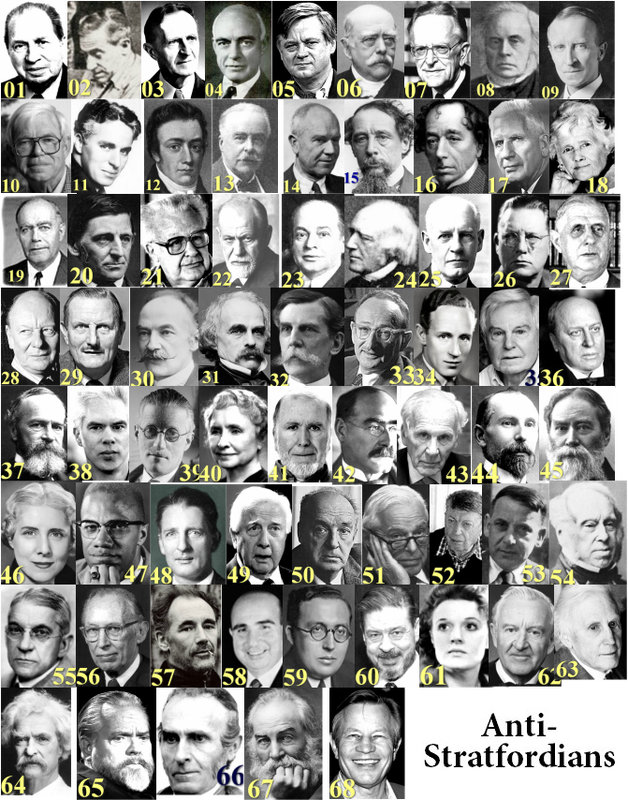
A tiny selection of Shakspere Doubters [Anti-Stratfordians]:
1,   2,   3,   4,   56,   7,   8,   9 
10,  11121314,   1516,  1718,
19,  20,   21222324252627,
2829,  30,   31,  32,  33,   34,  3536
3738394041,  42434445,
464748495051525354,
555657585960616263,
6465666768 .-   

Historically,  the second step and (re)search („If is was not the Stratfordman, who was it ?“)  wouldn’t have taken place without the first ..-

Since Stratfordians denied  to take the first step they more or less had to declare the Non-stratfordians with all their arguments and critical thinking (conscious and unconscious) from the beginning as truthers or conspiracy theorist …that is to say as mad or crazy people.

The spearhead of the Stratfordians, the  "Red  Oxfraud Berets", or "Orthodox "Ant-Anti-Stratfordians", an interesting microscopic group of a mentally armed "Special  Stratfor(d) Task Force" of cloaked intelligence with their unofficial warrior diplomats (Mike Leadbetter, Tom Reedy, [his favorite word is "Pissing"] Mark Johnson, Nemo Whilk etc ) draw a clear position  on their Webpage:

"Any person with a studied view of the debate knows that the case for Shakespeare is solidly documented in the historical record. What we're interested in is .......why anti-Stratfordians deny that record. We're not here to give each other high-fives."

It is astonishing (more than refreshing) to observe the  Oxfraud "Red Berets" most often feeling seemingly in a joyful  superior position compared to  the ineradicable group of  old fogeys Anti-Stradfordian....,


https://www.youtube.com/watch?v=dkx7ChWkRvc